
SEO reporting used to be a lagging indicator where you’d see the traffic drop, then scramble to figure out why.
Today, the reporting landscape is shifting. A growing share of SaaS research now runs through AI engines like ChatGPT, Perplexity, and Google AI Overviews. Standard analytics tools weren’t designed to track that.
You can rank well in classic SERPs and still be invisible in the answers your buyers actually read. Even digital marketing companies like SEOptimize are actively rethinking what “visibility” means when AI systems sit between search and your site.
That shift is forcing founders to ask a different question. It’s no longer about just “where do we rank,” but “where do we show up when AI does the summarizing.”
In this article, we’ll explore the AI SEO tools that help you forecast those shifts early, map them to revenue pages, and act before the damage shows up in your metrics.
What Separates a Predictive SEO Tool from a Reporting One
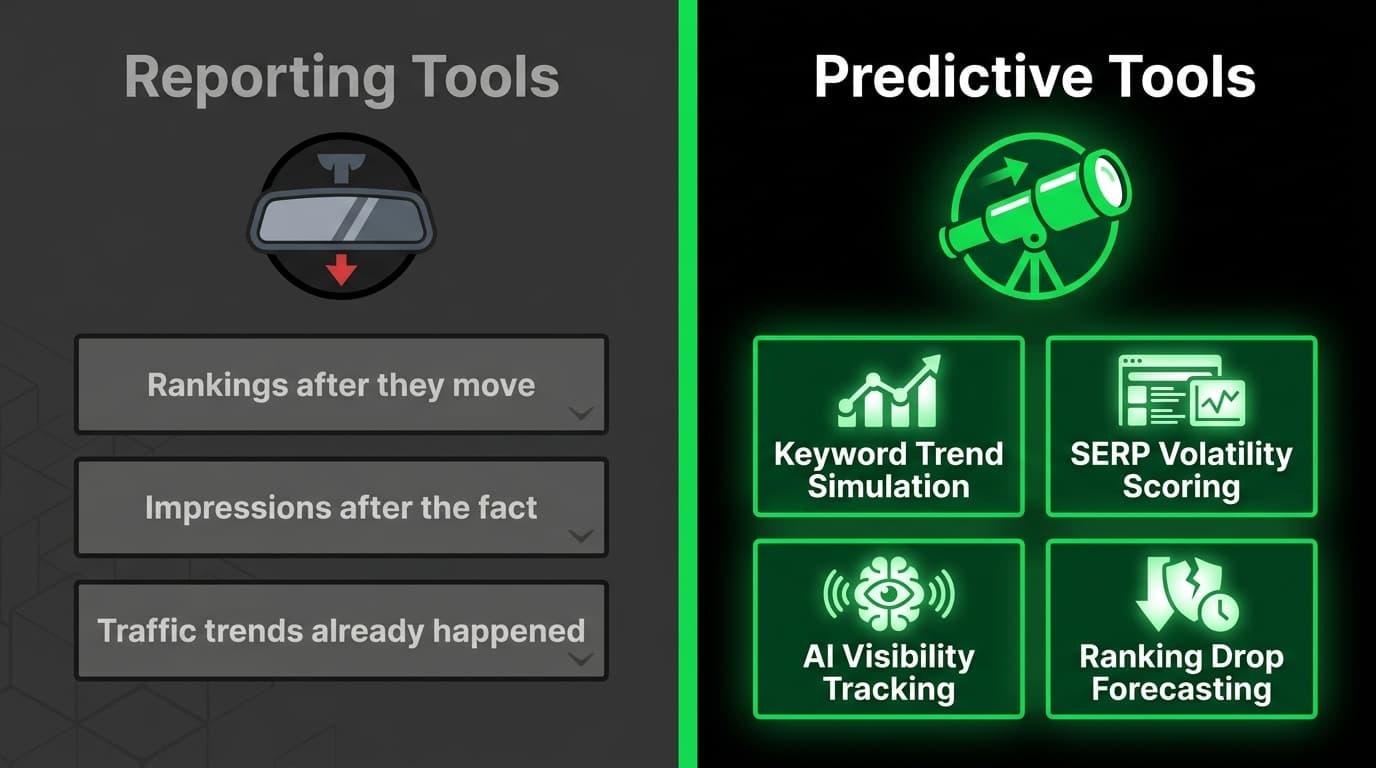
Most SEO tools are built to explain the past. Predictive tools are built to reduce future risk. It’s important to understand this distinction when making budget decisions or planning a product launch around organic traffic.
Reporting tools show you rankings, impressions, and traffic trends after they’ve already moved. Predictive tools model what’s likely to shift next and give you enough lead time to act. Their core capabilities include:
- Keyword Trend Simulation: Models how search demand for your target keywords is moving over time, so you can see whether a topic is rising, flat, or declining before you commit budget to it.
- SERP Volatility Scoring: Flags how unstable a search results page is for your keywords, helping you avoid pouring effort into terms where rankings whip around every time Google ships an update.
- AI Visibility Tracking: Monitors how often your brand, product, and key pages show up inside AI-generated answers in tools like ChatGPT and Google AI Overviews so that you can treat GEO as a measurable channel instead of a black box.
- Ranking Drop Forecasting: Identifies pages that are trending toward a decline in visibility based on early signals, giving you a chance to reinforce those URLs before the traffic and the demos they drive start to fall.
Why Forecasts Must Follow the Money
For SaaS founders, the bar is higher. Generic forecasting isn’t enough. The tool also needs to be able to connect traffic projections to the pages that actually drive the pipeline. These pages can include demo request pages, pricing pages, and trial sign-up flows.
What use is a forecast if it skips the pages that sell? A blog post losing rankings is usually a content problem. A pricing page losing visibility often signals a revenue problem. That’s the line where SEO metrics turn into board-level questions about future revenue.
When the stakes are that high, you also need to know when external forces, like algorithm updates, are about to move the ground under those pages.
Algorithm update preparedness is another filter worth applying. Strong tools surface SEO forecasting methods and volatility windows in advance. Weaker ones simply update your position tracking after the damage is done.
The AI SEO Tools SaaS Founders Are Actually Using
Not every tool that calls itself “AI-powered” is built for forward-looking decisions. The ones worth paying for share a common trait: they tell you what’s likely to happen next, not just what already happened.
Here’s how the most-used options break down by forecasting function.
| Tool | Primary Forecasting Function | SaaS Use Case |
|---|---|---|
| Semrush | Keyword trend simulation, competitor traffic modeling | Projecting demand before a content bet |
| Ahrefs | Keyword opportunity windows, historical trajectory | Identifying gaps before competitors do |
| SE Ranking | SERP volatility tracking | Anticipating algorithm turbulence |
| AccuRanker | Daily SERP instability signals | Ranking drop early warning |
| MarketMuse | Topic modeling, topical authority scoring | Demo and pricing page pipeline risk |
| Profound | AI answer visibility tracking | Brand mention monitoring in ChatGPT and Perplexity |
| Otterly AI | GEO tracking across AI engines | Competitor citation detection in AI answers |
Founders should evaluate each ai seo platform based on the specific growth bottleneck it solves.
Before buying, create a simple checklist to compare seo platforms effectively.
Semrush and Ahrefs: Keyword Trend Simulation at Scale
These two are among the most widely used AI-powered SEO tools for SaaS companies for a reason: they’ve built forecasting layers on top of what started as reporting infrastructure, helping SaaS teams scale keyword research.
Semrush’s Keyword Magic Tool surfaces demand trajectory alongside volume data, which helps you read search volume and search volume trends before committing content resources. That means you’re not just seeing how many people searched a term last month; you can also see whether that number is climbing, plateauing, or declining.
Pair that with Traffic Analytics, and you can model competitor traffic shifts before they show up in your own Google Search Console data. For a SaaS founder planning a content push around a new feature, that’s the difference between betting on a rising keyword and chasing one that already peaked.
Ahrefs, on the other hand, brings a different angle through its Site Explorer and the Content Gap tool. It also offers real-time keyword analysis, competitive intelligence, and deeper keyword data for competitor analysis. The historical trajectory data on keyword rankings lets you identify which opportunities are opening up, not just which ones exist today.
Would you rather chase crowded terms or move first where gaps are opening?
If a competitor’s page has been slowly losing ground on a high-intent term for over six months, that’s a signal worth acting on immediately, not after they’ve already recovered. Google Search Console shows you your own data reactively, while Ahrefs is stronger for competitive research around emerging opportunities.
SE Ranking and AccuRanker: SERP Volatility and Ranking Drop Prediction
Both tools address a specific problem that all-in-one platforms tend to underserve: knowing when the SERP environment itself is unstable before your rankings move.
SE Ranking’s SERP Volatility tracker monitors turbulence across keyword categories in real time, and the platform also delivers daily rank updates across desktop and mobile. When algorithm activity spikes, you see it before it hits your position data. SE Ranking also supports real-time ai search visibility monitoring alongside rank tracking, which helps teams catch changes outside classic SERPs. That lead time is important because if you’re about to publish a cluster of content targeting competitive SaaS keywords, knowing that Google is mid-update changes the timing decision entirely.
AccuRanker’s Grump score gives a daily read on SERP instability across the broader index. It’s a blunt instrument in the best way: a single signal that tells you whether today is a day to trust your ranking data or treat it as noise.
For SaaS founders who check rankings weekly and make decisions based on them, this kind of volatility context prevents bad calls during turbulent windows.
MarketMuse: Content Opportunity Forecasting for SaaS Pages
MarketMuse operates differently from the tools above. Instead of just reporting on what’s already ranking, it uses AI for content strategy, content optimization, and topic suggestions by modeling the topical authority you’d need to build to rank and projecting how content gaps affect your overall domain competitiveness.
For SaaS companies, this matters most when improving high-intent pages where stronger page optimization directly affects the pipeline, such as:
- Demo request pages (e.g., “Book a demo” or “Talk to sales” forms)
- Pricing pages with plan comparison tables
- Free trial sign-up pages and onboarding flows
- Feature comparison pages against key competitors
- Integration pages that drive high-intent sign-ups (e.g., “Connect with Salesforce”)
MarketMuse’s topic modeling scores those gaps, identifies missing topics and semantic themes needed to build high topical authority, and gives you a projected authority trajectory if you close them. That’s real forecasting input, not just a content audit, and it’s the kind of signal that connects directly to the pipeline risk framework covered later in this article.
Profound, Otterly AI, and GEO Platforms: AI Visibility Tracking Across ChatGPT, Perplexity, and Google
This is the category most AI SEO tools for B2B SaaS growth teams haven’t caught up to yet. As a growing share of SaaS research queries flow through ChatGPT, Perplexity, and Google AI Overviews, standard rank tracking becomes an incomplete picture, so teams increasingly need tools that monitor ai search platforms and performance inside ai search environments, not just traditional SERPs.
An estimated 40% of SaaS buyers will start research using AI answer engines by 2026, which is why this category matters.
Tools in this space help teams measure brand visibility where buyers are actually discovering solutions. They also show that AI SEO tools can track visibility across AI search platforms like ChatGPT, while platforms like Profound tracks brand visibility across AI answer engines and citations.
That broader shift matters because AI-powered SEO for SaaS companies is shifting to Generative Engine Optimization (GEO), and now toward ai search optimization as buyers rely more on ai search and ai search engines.
Profound
Profound tracks where your brand and product appear in ai responses and citations across AI engines like ChatGPT. This improves brand visibility by showing whether your product is actually being surfaced in answer-engine outputs. If a prospect asks ChatGPT to recommend a project management tool for SaaS teams and your product isn’t mentioned, that’s a visibility gap that no traditional rank tracker will surface.
Otterly AI
Otterly AI extends this into Generative Engine Optimization (GEO) territory, flagging when a competitor’s content is being cited in AI answers instead of yours and helping you monitor ai generated search results where competitor citations replace your own content.
That’s an early warning system for share erosion in AI-driven search, the kind of signal that shows up months before you’d see it in traffic data, and it matters for search visibility when AI-generated answers influence buyer decisions before a click occurs.
Among the tested SaaS SEO tools ranked for 2026, these GEO platforms stand out for how directly they focus on AI-driven search. They don’t replace traditional SEO tools. Instead, they fill the blind spot around how your brand shows up inside AI answers, something older platforms were not built to track.
Which Tools Fit Your SaaS Stage and Budget
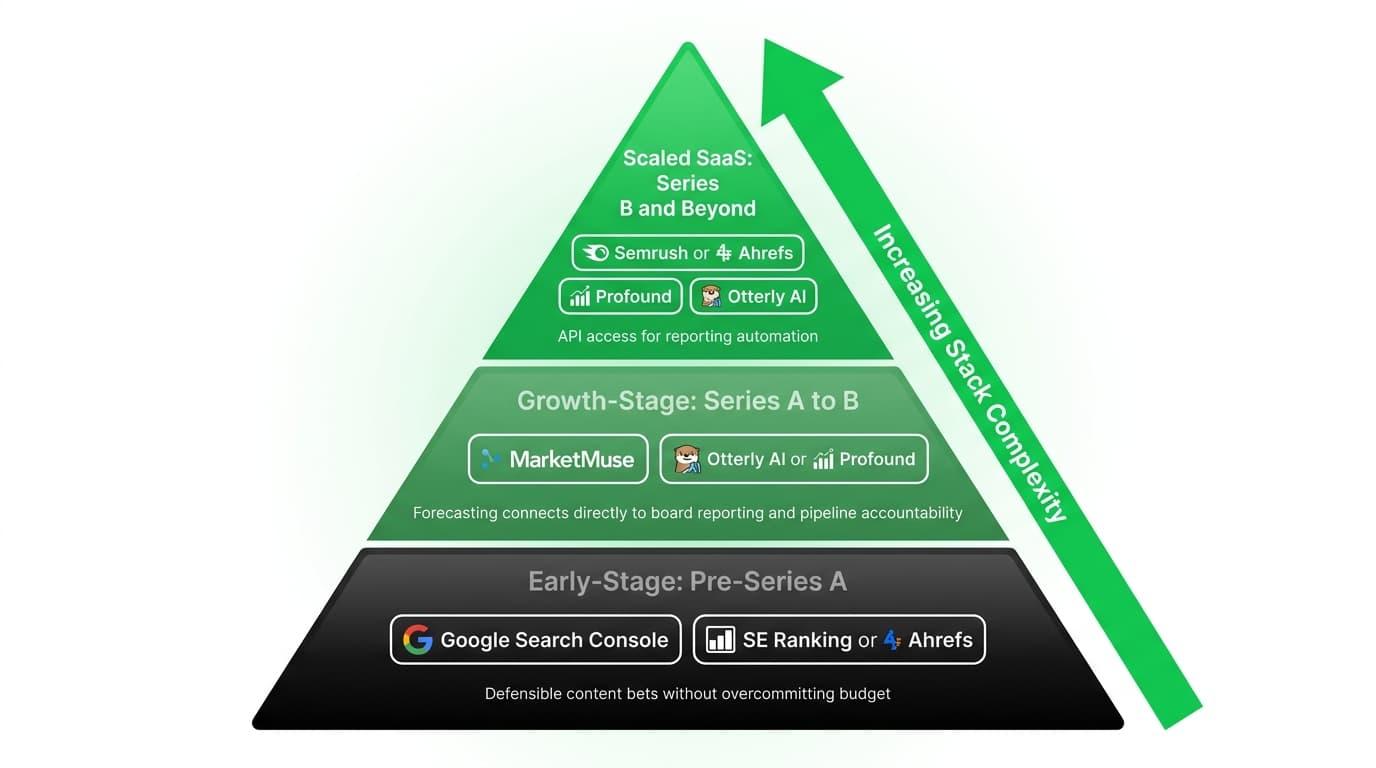
Not every tool on this list makes sense at every stage. The right stack depends on where you are, what decisions you’re making, and what a misallocated content sprint actually costs you.
Here’s a practical breakdown by growth stage.
Early-Stage Founders (Pre-Series A)
Start with Google Search Console as your forecasting baseline. It’s free and surfaces real demand signals from your actual audience. Pair it with SE Ranking or Ahrefs to add SERP volatility context and keyword trajectory data without the enterprise price tag. That two-tool combination gives you enough signal to make defensible content bets without overcommitting budget.
Growth-Stage Teams (Series A to B)
At this stage, forecasting connects directly to board reporting and pipeline accountability, and growth-stage companies often need all-in-one platforms to support scaling. Start feeding data from MarketMuse into the model to identify topical authority gaps on your highest-value pages, and start tracking AI visibility with Otterly AI or Profound. These tools also help marketing teams with content briefs and draft support as content production expands.
As more SaaS research queries flow through ChatGPT and Perplexity, knowing whether your brand appears in those answers becomes a pipeline question, not just an SEO one.
Scaled SaaS (Series B and Beyond)
Full-stack forecasting applies here, and scaled seo teams often need specialized tools on top of core platforms because enterprise sites carry more technical complexity. Use Semrush or Ahrefs for keyword simulation at scale, MarketMuse for content authority modeling, and both Profound and Otterly AI for GEO tracking across AI engines.
Larger stacks often include api access for reporting automation and workflow customization.
At this stage, predictive SEO becomes a weekly boardroom input, not just a marketing function. The SaaS SEO strategy shifts from “how much can we publish” to “which pages and keywords should we back first based on risk and upside.”
Regardless of stage, predictive SEO tooling pays for itself when it prevents one misallocated content sprint or catches one ranking drop before it hits demo request volume. That’s the threshold worth measuring against.
How Ranking Drop Forecasts Connect to Churn and Pipeline Risk
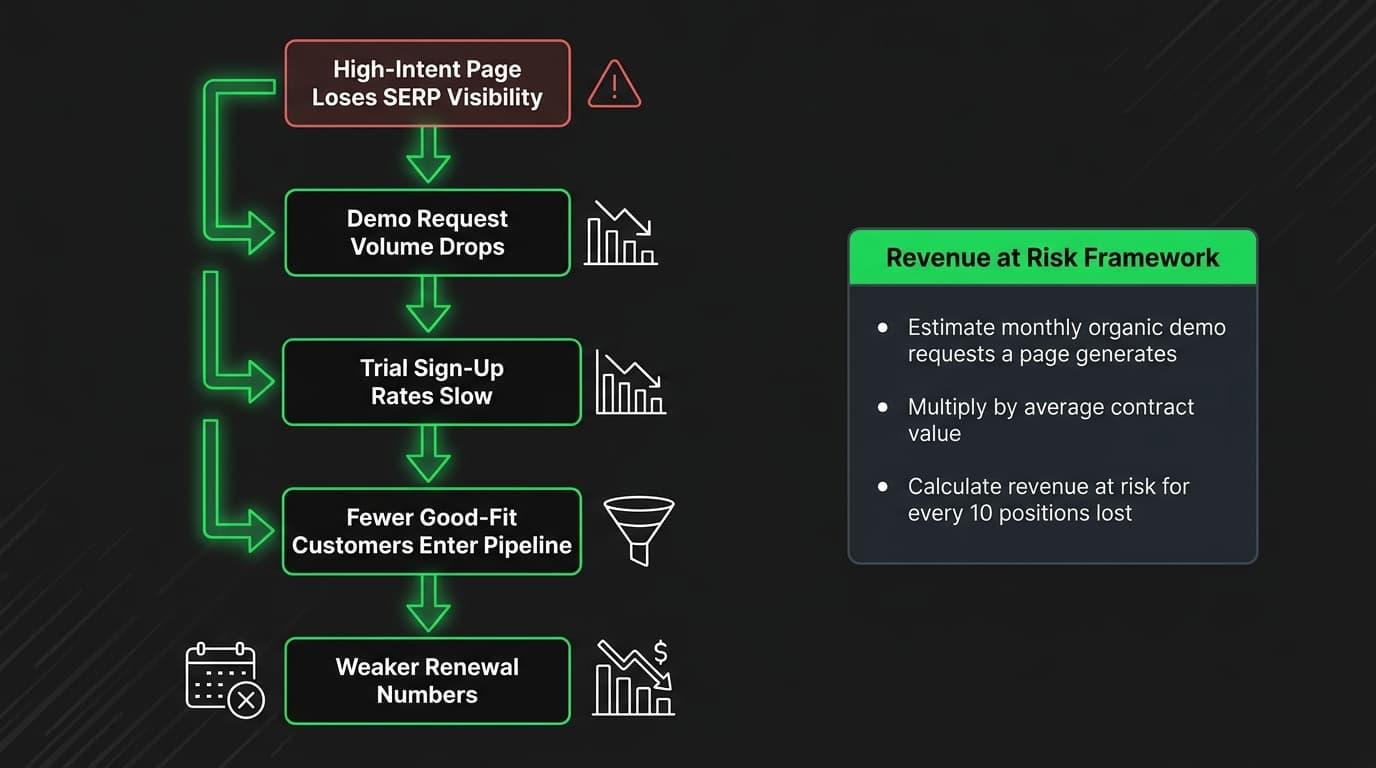
A ranking drop on a pricing page isn’t an SEO event. What it really is is a pipeline event. That distinction changes how you respond to it and, more importantly, how you justify the tools that help you see it coming.
When a high-intent page loses SERP visibility, the impact spreads quickly downstream. Demo request volume drops. Trial sign-up rates slow.
In B2B SaaS, buying cycles are longer, so losses on high-intent queries compound over time, especially when the page no longer aligns with search intent and user intent.
A traffic gap early in the year often turns into weaker renewal numbers later because fewer good-fit customers ever made it into your pipeline in the first place.
Predictive tools that flag SERP volatility a few (two to four) weeks ahead give teams enough runway to act. That could mean strengthening content on a key page before it slides, or tightening internal links to support a high-converting URL. The window is short, but it’s usually long enough to soften or even prevent the worst of the drop.
Here’s a framework worth taking into a leadership meeting:
- Estimate the monthly organic demo requests a page currently generates.
- Multiply that by your average contract value.
- Calculate the revenue at risk for every 10 positions lost on that page.
- That number is what predictive tooling is actually protecting.
Optimizing product pages to earn citations in AI overviews can also lift click-through rates by up to 35%.
Calculating What a Ranking Drop Really Costs
That math tends to reframe the conversation. A tool subscription that costs a few hundred dollars a month looks different when it’s sitting next to a six-figure pipeline exposure.
Algorithm update preparedness fits into this same frame. SE Ranking’s volatility index and AccuRanker’s Grump score both surface high-turbulence windows before your rankings move.
The practical playbook is simple. When volatility spikes, hit pause on risky changes and do not migrate key pages. Don’t restructure internal links. Wait for the index to stabilize.
A SaaS team that caught a volatility window 3 weeks early and paused a planned site migration can avoid an estimated 30-40% traffic loss to their highest-converting landing pages.
That could mean strengthening content on a key page, tightening internal links, or using AI tools to optimize schema markup for better search engine categorization before losses deepen. That kind of outcome is what SERP analysis and AI visibility tracking tools are built to enable.
Answer engine optimization (AEO) adds another layer here. As more pipeline-stage queries flow through AI engines, a brand that loses citation visibility in those answers faces a compounding risk that standard rank tracking won’t catch until it’s already reflected in traffic data.
Where Predictive Tools End and Founder Judgment Begins
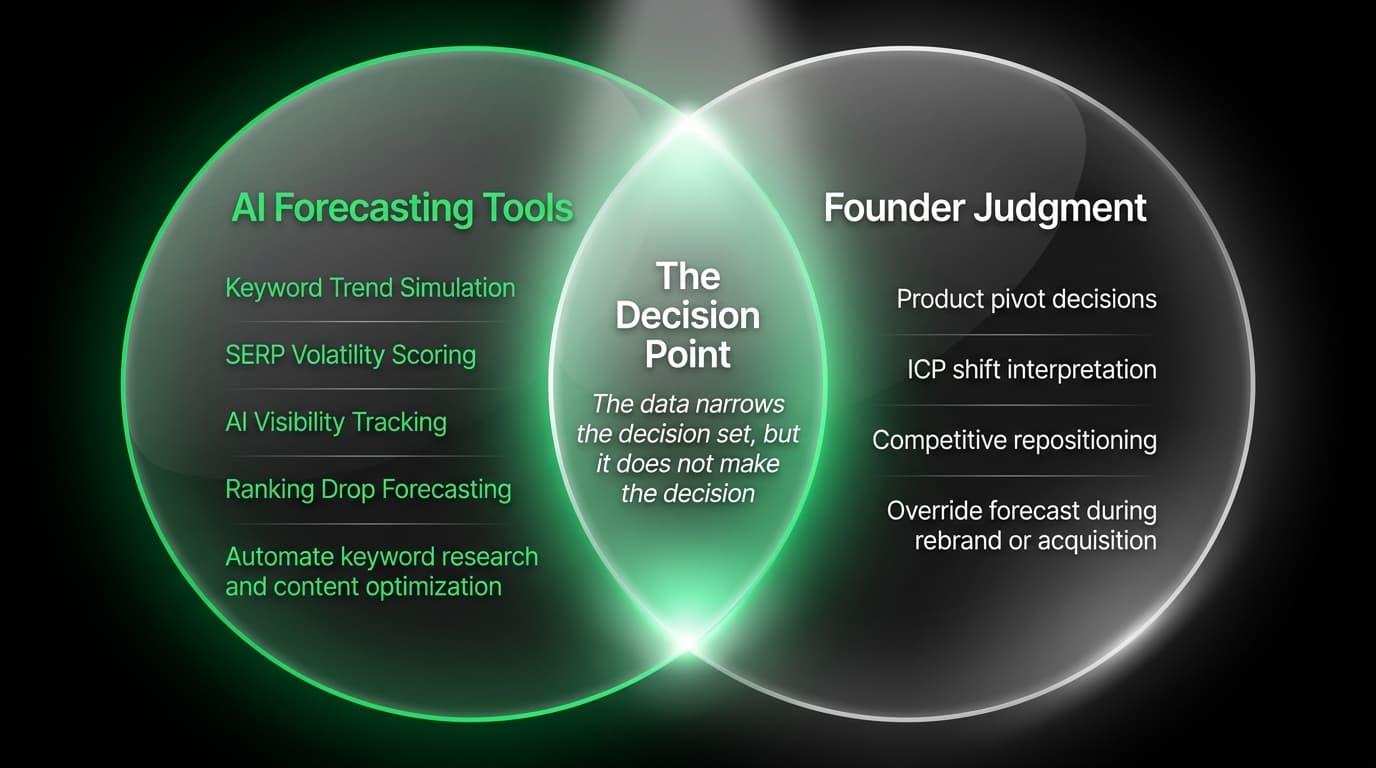
No AI forecasting tool predicts algorithm updates with certainty, even though AI can analyze massive datasets faster than humans in SEO tasks. What they surface are probability signals such as volatility patterns, traffic trajectory shifts, and SERP instability windows. Understanding this is important because treating a forecast as a guarantee is how teams make confident decisions on bad assumptions.
There are also things these tools simply cannot model. These include:
- A product pivot that changes which keywords actually matter for your business
- An ICP shift that redefines what “high-intent” looks like for your team
- A competitive repositioning that makes previously irrelevant terms suddenly worth owning
Historical data patterns can’t account for any of that, and no tool will tell you when your own strategic context has made the forecast structurally obsolete.
This point is where your judgment as a founder comes into play, evaluating the actual variable. AI SEO tools automate keyword research and content optimization tasks, but founders still have to interpret that output against real customer problems. AI algorithms also evaluate search queries to infer what prospects are trying to solve, which is useful but still incomplete without business context. A predicted traffic drop on a page means nothing without someone who understands what that page does for the pipeline. The data narrows the decision set, but it does not make the decision.
Specific technical SEO moments call for overriding the forecast entirely. Examples include:
- Entering a new product category
- Going through a rebrand
- Acquiring a company with a different keyword footprint.
In each case, the historical patterns the tool is modeling no longer reflect the business you’re actually running.
Build Your Forecasting Stack Before the Next Algorithm Shift
Reactive SEO is expensive. By the time the traffic drop shows up, the pipeline damage is already in motion. The right predictive stack depends on your growth stage and which business metrics you can’t afford to lose visibility on.
A complete stack may also include a content editor like Surfer SEO to guide drafts around a target keyword, analyze top-ranking pages, help teams optimize for traditional search and AI search, and shape content to match search intent, with Google Docs integration useful inside writer workflows.
Tools like Clearscope also show that optimization is not just keyword density; the goal is high quality content aligned to intent, and content optimized with Clearscope often ranks faster and higher.
At SEOptimize, we work with SaaS founders as a strategic partner, not just a tool recommendation service. If you’re ready to move from reporting on what happened to forecasting what’s coming, our SaaS SEO services are built exactly for that, and an seo agency can also help choose the right mix of keyword research tools, content workflows, and reporting.
Contact us today and let’s build a forecasting stack that protects your pipeline before the next algorithm shift hits.