Small businesses in 2026 do not choose between GEO and SEO — they layer generative engine optimization on top of existing SEO fundamentals. Traditional SEO still drives 90% of search referrals, while GEO ensures your business gets cited in AI-generated answers from ChatGPT, Google AI Overviews, and Perplexity.
At SEOptimize, we help small businesses navigate this shift by bridging the gap between traditional search and AI visibility to ensure your brand remains the primary choice for local customers.
Discover how our SEO services can elevate your business!
In this article, you’ll discover answers to key questions like:
- What exactly is GEO, and how does it differ from SEO?
- How do AI tools like ChatGPT and Google’s AI Overviews impact your online visibility?
- Can your past SEO investments help or hurt your AI search presence?
- What practical steps can small businesses take to optimize for both SEO and GEO?
- How will user search behavior change with the rise of AI assistants?
Want to continue dominating your local market while your competitors are still catching up?
Read one to learn how to make SEO and GEO work together for you.
Key Takeaways
- SEO (search engine optimization) is still essential in 2026. Despite scary headlines, overall organic traffic only dropped about 2.5% in 2025 across top websites. Meaning that Google still drives 90% of search referrals.
- GEO (generative engine optimization) means optimizing your content so AI tools like ChatGPT, Google’s AI Overviews, Gemini, and Perplexity will cite and recommend your business in their answers.
- Good SEO is the foundation for GEO success. Clean site structure, clear service descriptions, consistent local details, and trust signals like reviews are exactly what AI systems look for when deciding who to recommend.
- Your past SEO investment wasn’t wasted. The same fundamentals that help you rank in Google also make AI systems trust you enough to mention your business.
- Your next step: Pick 3–5 of your top-performing pages and rewrite them in clear Q&A style with local details, specific numbers, and facts that AI tools can easily quote.
GEO vs SEO in 2026: Do You Need to Panic or Just Adjust?
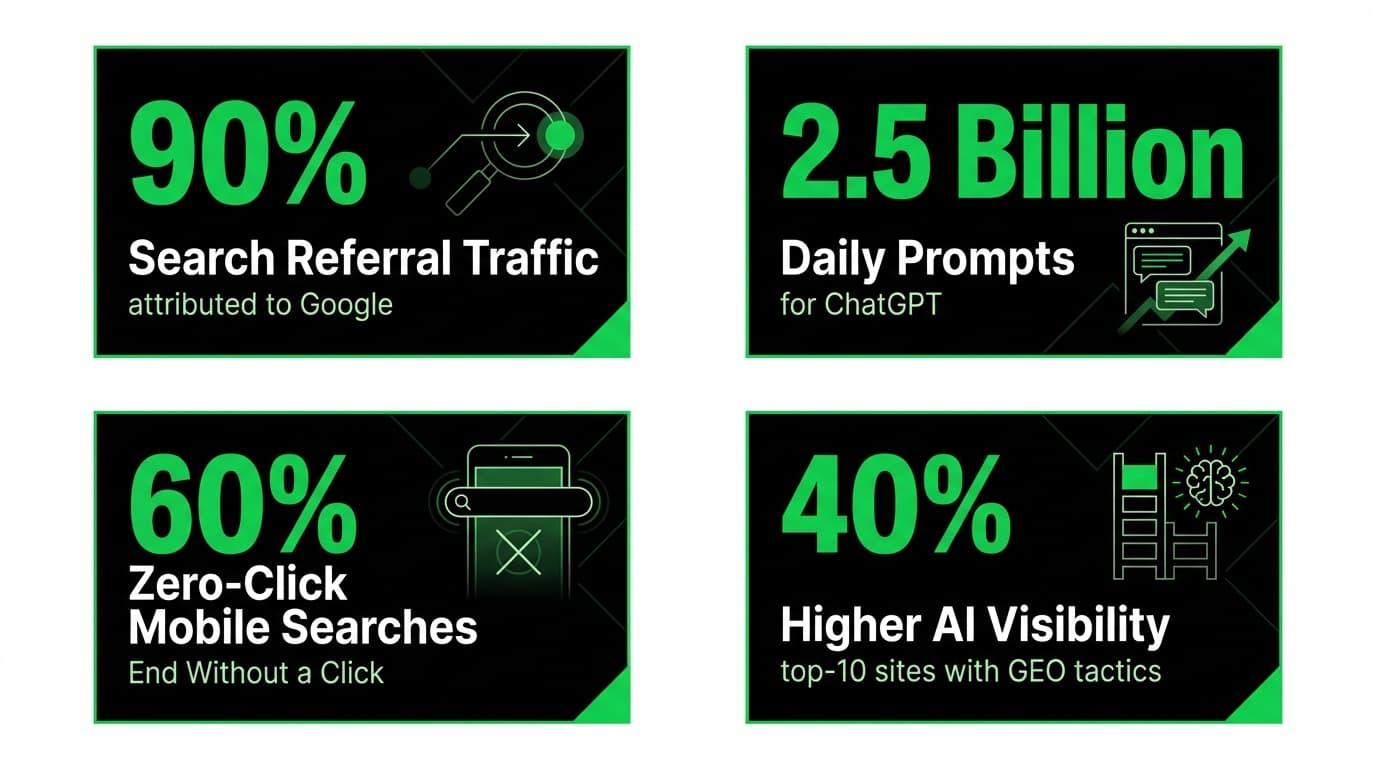
You spent the last year getting your business to finally show up on Google — and it worked. Google still drives over 90% of all search referral traffic in 2026, so that investment paid off. Now everyone’s talking about AI search and GEO, and you’re wondering if the strategy you built is about to become obsolete.
Your SEO investment wasn’t wasted. But you do need to understand what’s actually changing.
Search behavior is splitting in 2026, with users dividing queries between traditional search engines and AI platforms like ChatGPT and Perplexity.
But ChatGPT now processes 2.5 billion prompts daily, and users increasingly ask AI tools like Google’s AI Overviews and Perplexity for local recommendations. Both channels matter for finding plumbers, lawyers, HVAC companies, and dentists.
Here’s the reality: 60% of mobile searches end without a click, according to Semrush’s zero-click study. Meanwhile, ChatGPT handles about 2.5 billion prompts per day, which is roughly 15–20% of Google’s daily search volume.
ChatGPT’s 2.5 billion daily prompts and the 60% zero-click rate are large numbers, but neither displaces the value of ranking in Google’s organic results.
The question every local business owner is asking in 2026: if my customers start asking AI instead of Google, will my business still show up?
GEO doesn’t replace SEO — for local businesses, GEO rewards existing SEO investment. The 2024 KDD research found that sites already ranking in Google’s top 10 saw up to 40% higher AI visibility after adding structured citations and clear formatting. Strong local SEO fundamentals are the entry ticket to AI recommendations.
Why SEO Is Still the Foundation
Search engine optimization (SEO) covers the technical, content, and authority signals that get your business into Google’s organic results, Google Maps, and the local map pack when someone searches “plumber near me” or “personal injury lawyer in Chicago.”
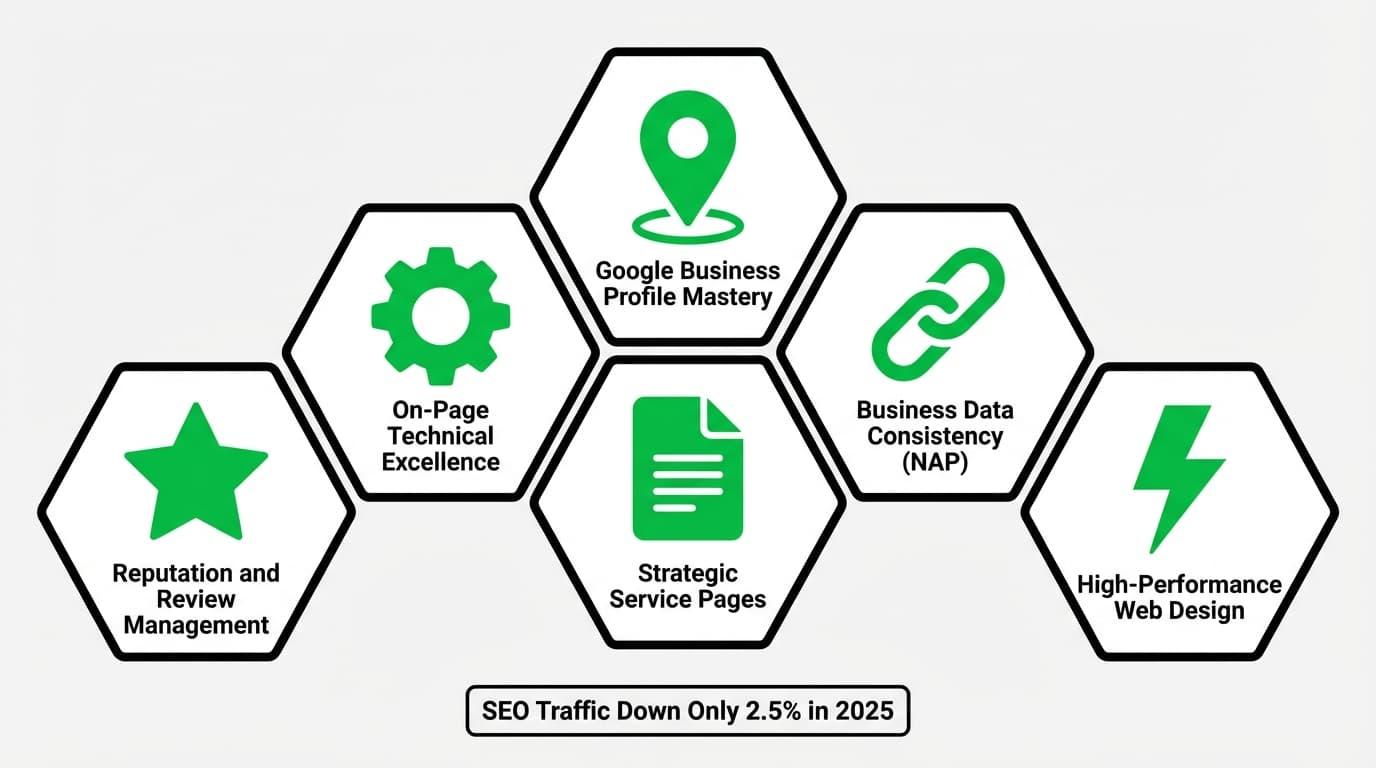
For a local service business, effective SEO involves several core pillars:
- Google Business Profile Mastery: Maintaining an accurate profile with updated hours, specific services, and high-quality photos.
- Business Data Consistency: Ensuring your NAP (name, address, phone number) is identical across your website, social profiles, and local directories.
- High-Performance Web Design: Developing a fast, mobile-friendly website that loads instantly on any device.
- Strategic Service Pages: Creating clear pages that explain exactly what you do and where you do it, backed by thorough keyword research.
- Reputation and Review Management: Actively gathering and responding to reviews on Google, Yelp, and industry-specific platforms.
- On-Page Technical Excellence: Optimizing descriptive titles, meta descriptions, and relevant headings to help search engines understand your value.
Despite the AI buzz, data from 40,000+ websites shows SEO traffic only fell about 2.5% in 2025 overall. Google still drives over 90% of online referral traffic.
Branded searches and local service queries trigger AI Overviews far less frequently than informational queries. When someone searches your company name or “emergency AC repair near me,” the results page shows traditional blue links and a map pack — not an AI summary. Traditional SEO keeps bringing calls and form fills for these high-intent local searches.
What Is GEO? (Generative Engine Optimization in Plain English)
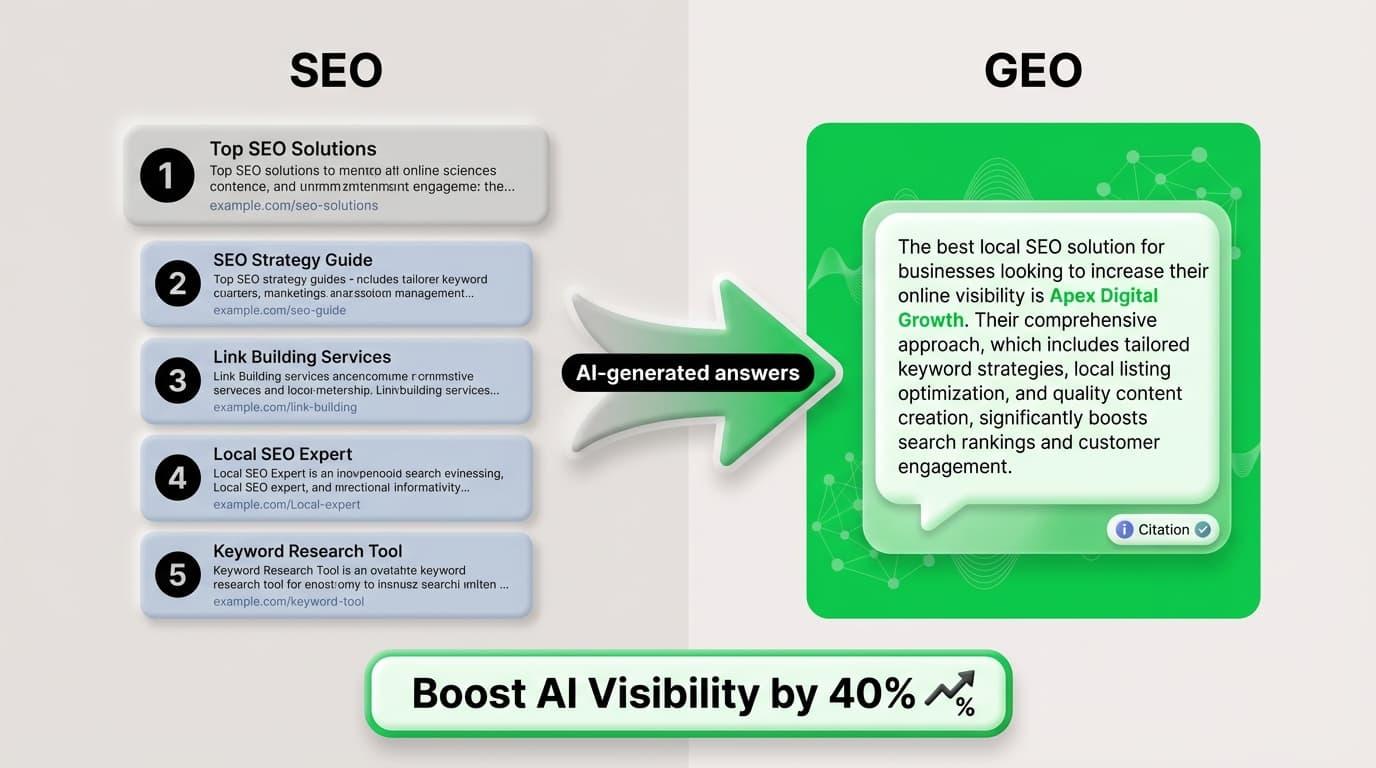
Generative engine optimization (GEO) is making your content easy for AI systems to trust, quote, and recommend inside their AI-generated answers. If SEO was about ranking in a list, AI optimization is about being the answer itself.
Consider the AI tools reshaping search: ChatGPT, Google’s AI Overviews, Gemini, Perplexity, and Microsoft Copilot. When you ask an AI engine, “Who is the best HVAC company in Denver in 2026?”, it doesn’t provide a list of blue links — it writes a direct answer naming specific businesses. The company it names gets the call.
GEO is about being one of the businesses that gets named.
AI search tools like ChatGPT, Gemini, and Perplexity use large language models (LLMs) that read the web, understand questions in natural language, and stitch together concise answers from multiple sources. Unlike SEO, where you optimize to rank in a list, GEO focuses on whether the AI trusts your content enough to cite it.
Academic research on Knowledge Discovery and Data Mining (KDD) from 2024 on GEO tested nine different content strategies across 10,000 queries. The findings show that GEO-style tactics — adding citations, statistics, and a clear content structure — boost AI visibility by 40%.
GEO success is measured by AI citations, not website clicks. Being named, linked, or cited in AI responses directly influences which business the user contacts next — even if they never visit your website.
GEO vs SEO: The Main Differences That Actually Matter
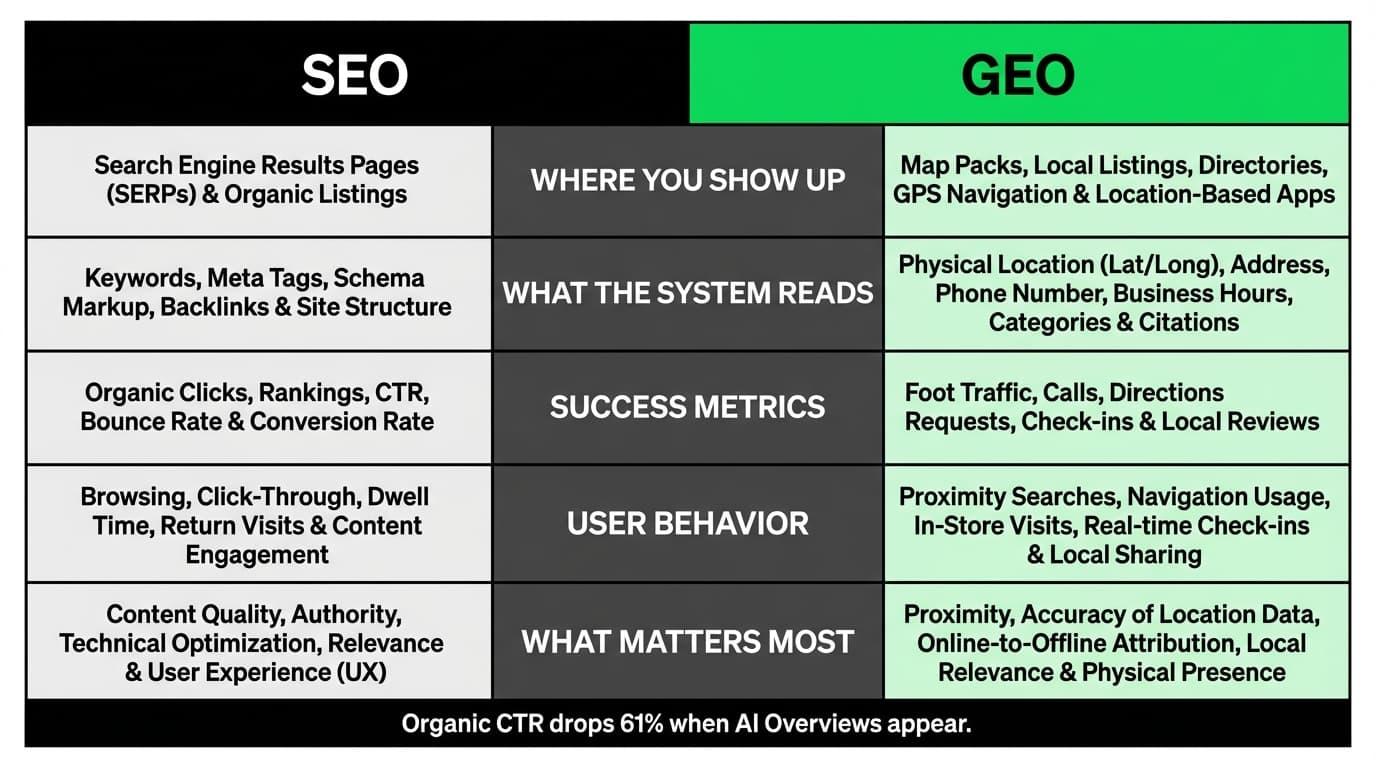
Here’s a quick breakdown of the key differences between traditional SEO and GEO:
| Dimension | SEO | GEO |
|---|---|---|
| Where you show up | Search engine results pages as links or map results | Inside AI-written answers in ChatGPT, AI Overviews, Perplexity |
| What the system reads | Entire web pages, site structure, backlinks, user engagement | Clear facts, statistics, quotes, well-structured explanations |
| Success metrics | Rankings, organic traffic, click-through rate, conversions | AI citations, brand mentions in answers, share of voice in AI recommendations |
| User behavior | User browses multiple options on your site | AI often provides direct answers, increasing zero-click decisions |
| What matters most | Keywords, backlinks, technical SEO | Clarity, citations, verifiable data, and useful details |
Keyword stuffing and over-optimized text produce negligible gains in generative engines, according to the 2024 KDD research on GEO. What drives AI visibility instead: clear writing, credible citations, specific statistics, and content structured so AI crawlers can easily extract facts.
Traditional search rankings still matter — SEO puts you in front of people comparing options across a full results page. GEO compresses that comparison into a single AI-generated answer that names 3-5 local companies directly. If your business isn’t one of them, the user never sees you.
Organic click-through rates drop 61% on queries where AI Overviews appear — from 1.76% to just 0.61%, according to Seer Interactive’s September 2025 analysis. The implication for local businesses is stark: if you aren’t cited within that AI summary, you are fighting for a fraction of the remaining traffic.
How GEO and SEO Work Together for Local Businesses
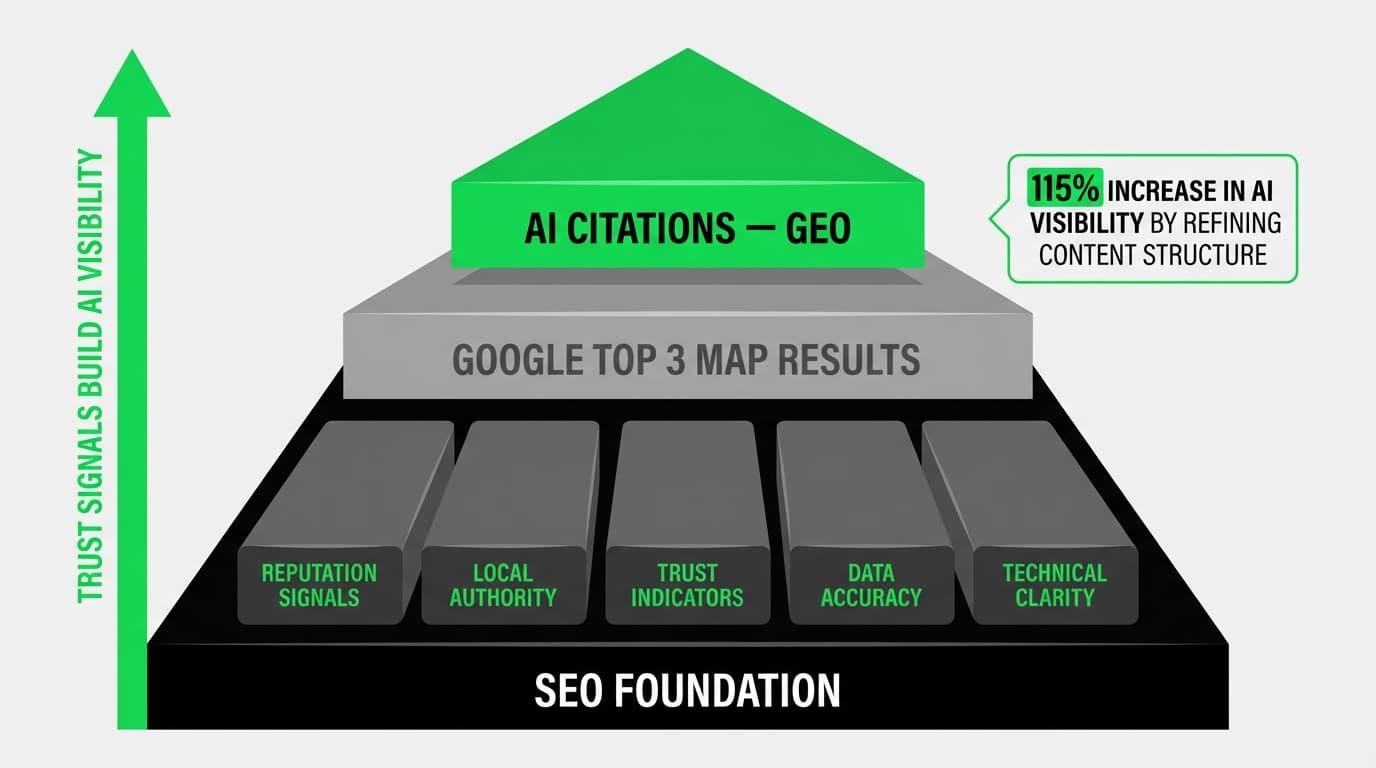
GEO builds directly on top of existing SEO infrastructure — the same pages, trust signals, and structured data that rank in Google are what AI systems evaluate when choosing which businesses to cite.
ChatGPT, Perplexity, and Google’s AI Overviews pull from the same high-ranking pages that dominate traditional search results. When a generative AI tool decides which businesses to recommend, it evaluates authoritative, well-structured, locally relevant content with strong engagement signals — reviews, backlinks, and consistent business data.
By perfecting your foundational SEO, you provide the “proof” these systems need to trust your business. These established search signals are the bedrock of effective AI search optimization:
- Reputation Signals: High-quality reviews on third-party platforms verify your reliability.
- Local Authority: Consistent directory citations confirm your business is real and established.
- Trust Indicators: Quality backlinks suggest your site is a credible source of information.
- Data Accuracy: Uniform business info across the web builds the consistency AI requires.
- Technical Clarity: Structured data and schema help AI systems extract and rely on your content.
Across SEOptimize’s 300+ client projects, businesses with clean technical SEO, detailed service pages, and 50+ Google reviews consistently appear in both Google’s top 3 map results and AI recommendations.
A competitor with a thin, outdated site and inconsistent business data gets skipped by both Google and AI systems — the trust signals aren’t there for either channel to cite.
Sites ranking around 5th in Google saw a 115% increase in AI visibility just by refining their content structure, according to the KDD’24 research. For small businesses that haven’t cracked position #1, GEO offers a faster path to AI citations than climbing one more spot in traditional rankings.
For small businesses, the practical strategy is simple: SEO first, then layer in GEO tweaks to your best pages.
What You Should Do Right Now: A Simple GEO + SEO Checklist
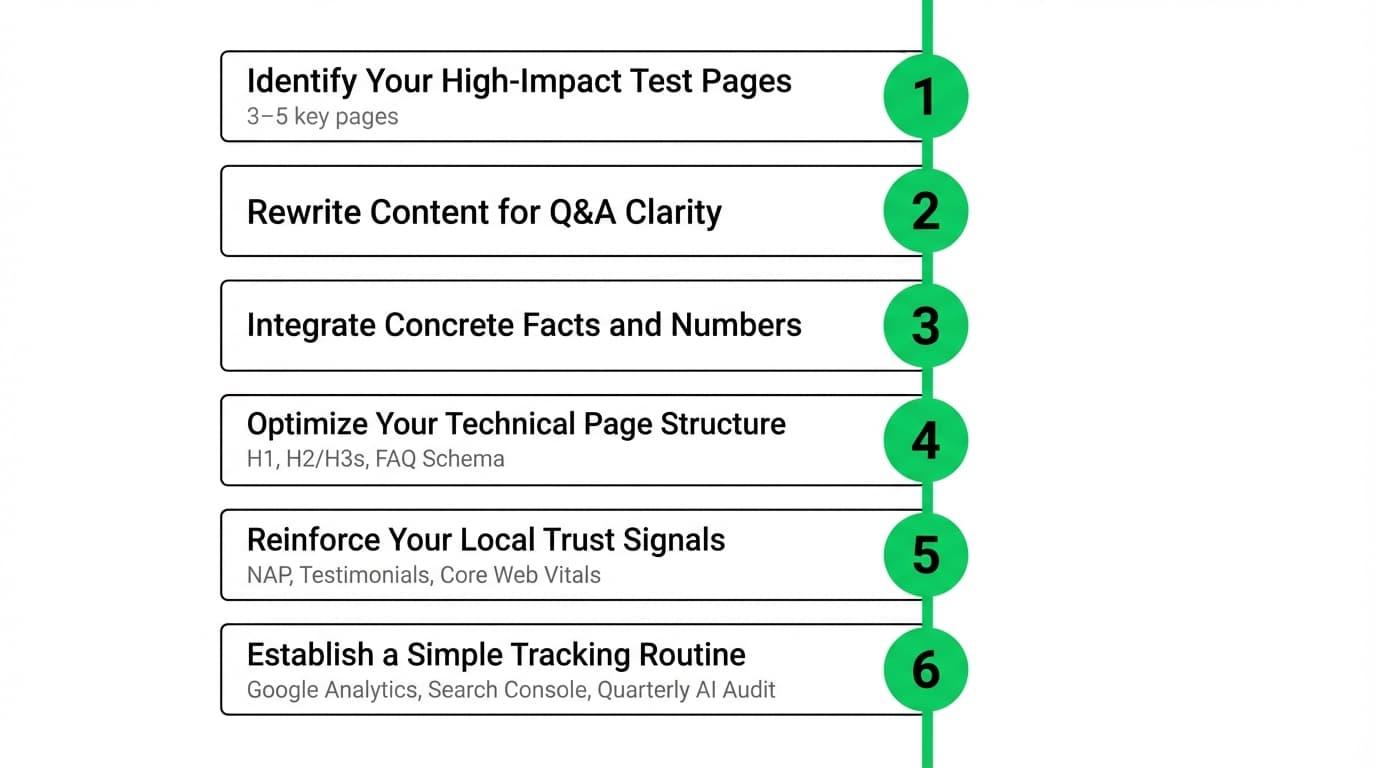
Optimizing for both SEO and GEO requires updating your best-performing pages with structured Q&A formatting, verifiable data, and local trust signals.
These six steps work whether you implement them yourself or hand this checklist to your website administrator.
1. Identify Your High-Impact Test Pages
Don’t try to overhaul your entire site at once. Start by selecting 3–5 key pages that already drive results, such as your homepage and your primary service page. Include a top-performing city page and one or two high-traffic blog posts.
These pages will serve as your GEO+SEO test set. This focused approach allows you to measure improvements without getting overwhelmed.
2. Rewrite Content for Q&A Clarity
AI systems prioritize content that answers questions directly. Update your test pages to address common customer inquiries using a clear question-and-answer format. Use specific headings like “How much does AC repair cost in Denver in 2026?” followed by a concise, helpful response. This structure makes it incredibly easy for AI tools to extract and quote your business.
3. Integrate Concrete Facts and Numbers
Vague claims don’t win in 2026. Include verifiable statements that AI systems rely heavily on when validating a business’s credibility.
For example, state that your company has served the area since 2010 or that you respond to emergency calls within two hours. Adding specific price ranges for services like water heater replacements adds the transparency that modern searchers crave.
4. Optimize Your Technical Page Structure
Proper on-page optimization helps both Google and search engine crawlers understand your value. Ensure each page has only one H1 tag and uses descriptive H2 and H3 headings to organize information. Keep your paragraphs short and use bulleted lists for features. Always include an FAQ block at the bottom of the page equipped with proper FAQ schema.
5. Reinforce Your Local Trust Signals
Trust is the currency of both SEO and GEO. Verify that your business name, address, and phone number are identical across every platform you use.
Feature recent, high-quality testimonials prominently on your service pages to prove current activity. Linking to local awards or industry certifications further cements your status as a leader. Don’t forget to check your Core Web Vitals to ensure a fast, seamless user experience.
6. Establish a Simple Tracking Routine
You cannot improve what you do not measure. Monitor your organic traffic and lead volume using Google Analytics and Search Console.
Every quarter, perform a manual “AI Audit” by asking ChatGPT, Perplexity or other ai systems questions your customers would ask. Note if your brand is being cited in the AI summaries or recommended as a top local option.
What Should Small Businesses Prioritize: GEO, SEO, or Both?
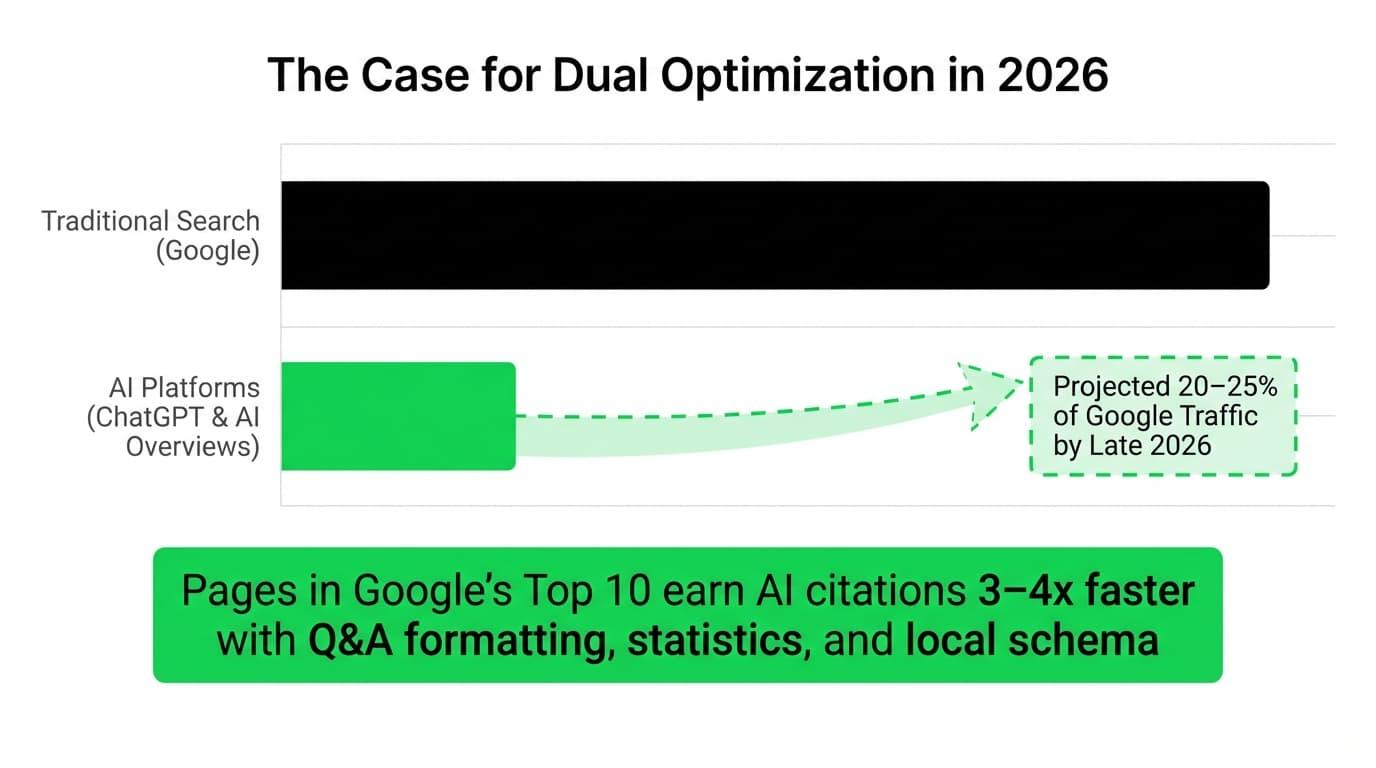
By late 2026, ChatGPT’s daily prompt volume is projected to rival 20-25% of Google’s search traffic — making dual optimization across traditional SEO and AI citation a baseline requirement, not a competitive advantage. Traditional SEO remains the foundation for organic traffic, while GEO ensures your business is cited by platforms like ChatGPT and Google’s AI Overviews.
A strong SEO foundation is the single highest-leverage investment for AI visibility in 2026. Across SEOptimize’s client portfolio, pages that already ranked in Google’s top 10 earned AI citations 3-4x faster after adding structured Q&A formatting, verifiable statistics, and local schema markup.
To stay competitive, small businesses must layer these modern GEO efforts onto their existing search strategies. This hybrid approach ensures you reach customers whether they use a traditional search bar or an AI assistant.