Showing up on Google Maps used to be enough. In 2026, it barely gets you in the door.
Local search is more competitive. Google’s AI Overviews are changing how profiles surface in results. And businesses that were “good enough” last year are quietly losing ground to competitors who are actively managing every lever.
At SEOptimize, we work exclusively with local service businesses to turn Google into a consistent lead source. This checklist covers every major GBP lever, from profile setup and review strategy to suspension risks and performance tracking. Nothing is left out.
Key Takeaways
- Complete profiles are 2.7x more trustworthy. Google’s own data shows customers are far more likely to consider a business reputable when its profile is fully filled out.
- GBP signals drive 32% of Local Pack rankings. That makes your profile the single highest-impact lever in local SEO (Whitespark, 2026).
- AI Overviews cut impressions, not actions. Calls and direction requests remain stable. Track those, not impressions.
- Review recency is now the #1 individual ranking factor, up from #20 in 2023 (Whitespark, 2026). Fresh reviews matter more than review count.
- NAP inconsistencies silently kill rankings. Even “St.” vs. “Street” introduces citation noise Google treats as a red flag.
- Google edits your profile without asking. If you are not checking weekly, unauthorized changes are already live on your listing.
- GBP alone has a ceiling. It compounds when paired with localized content, schema markup, and clean citations across the web.
Why GBP Optimization Matters More in 2026 Than Ever Before
The data isn’t subtle.
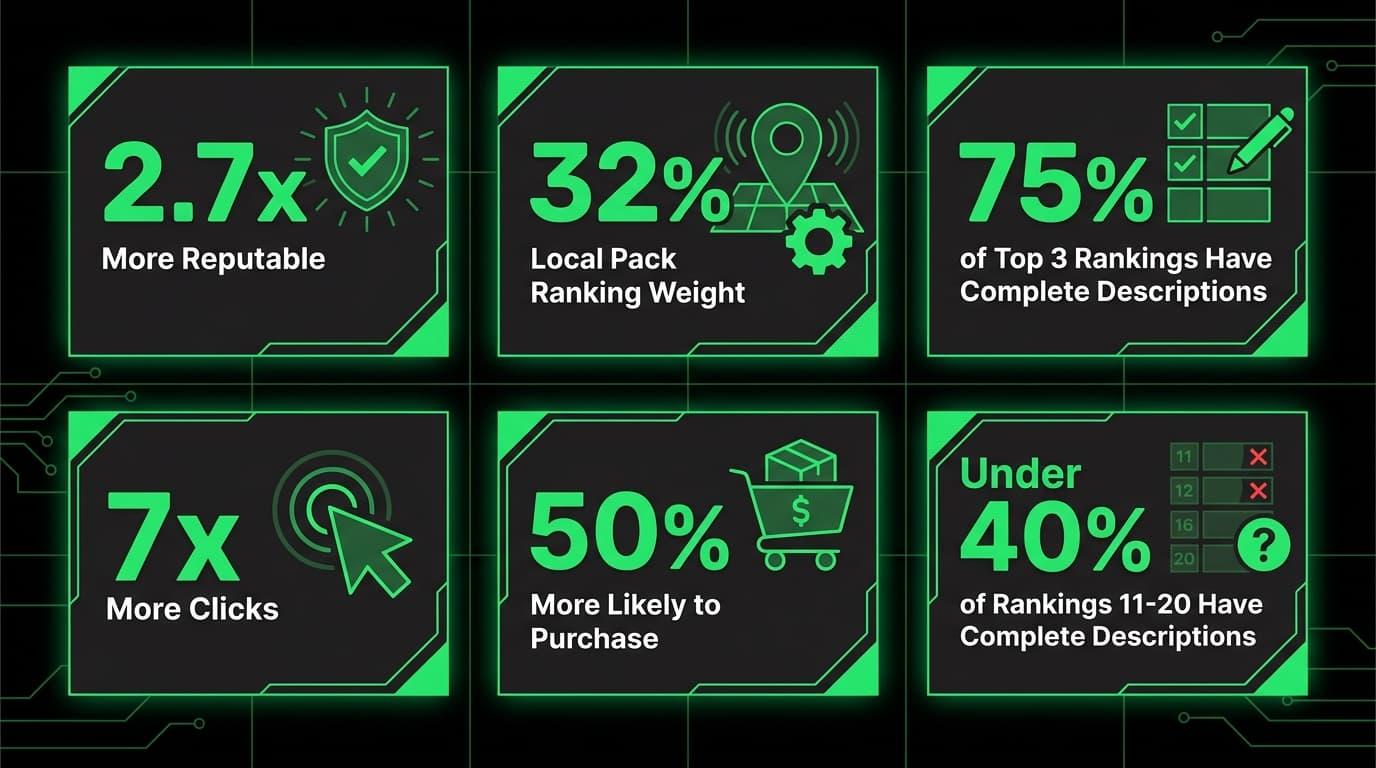
According to Google, businesses with complete profiles are 2.7x more likely to be considered reputable by potential customers, and customers are 50% more likely to purchase from them.
On the rankings side, the Whitespark Local Search Ranking Factors 2026 survey, drawn from 47 local SEO experts evaluating 187 factors, confirmed that GBP signals account for 32% of Local Pack ranking weight. That is the single largest block of ranking influence available.
And the gap between complete and incomplete profiles is measurable at scale:
- Localo’s analysis of 2 million+ profiles found that ~75% of businesses ranking in positions 1-3 had complete descriptions.
- Less than 40% of businesses ranked 11-20 had complete descriptions.
- Businesses with complete profiles get 7x more clicks in the SERPs, on average.
An incomplete profile isn’t a neutral choice; it’s an active handoff to the competitor who showed up where you didn’t.
SEOptimize starts every local SEO engagement with a full GBP audit. We identify every incomplete field, every misconfigured setting, and every missed opportunity before touching anything else. Profile completeness is the foundation on which everything else builds, not a nice-to-have option.
AI Overviews Changed the Impression Game, But Not the Action Game
If your GBP impressions have dropped recently, you’re not being penalized. You’re experiencing a structural shift.
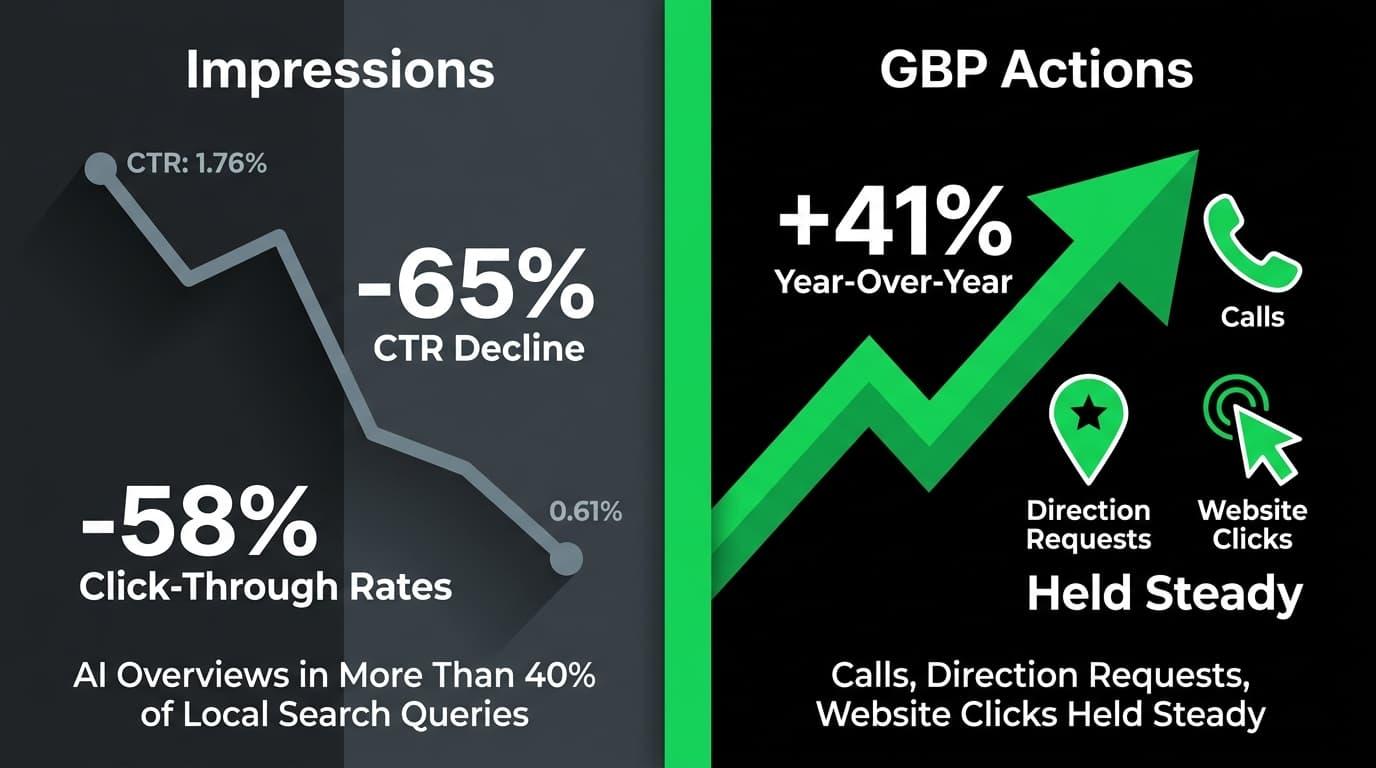
AI Overviews now appear in more than 40% of local search queries. Their presence has contributed to significant declines in impressions across the board.
Here’s what the data actually shows:
- Ahrefs analyzed 300,000 keywords in December 2025 and found that AI Overviews reduce click-through rates for top-ranking pages by 58% compared to pre-AI baselines.
- Seer Interactive tracked 25.1 million impressions across 42 organizations and found organic CTR dropped from 1.76% to 0.61% on AI Overview queries. That is a 65% decline.
But here’s what that panic misses entirely:
- GBP actions grew 41% year-over-year between 2025 and 2026. Calls, direction requests, and website clicks from GBP listings held steady.
- What AI Overviews filter out is the passive browser. What remains are buyers with the intent to act.
The Shift This Creates for Your Strategy
Stop measuring impressions as your primary KPI. Track calls and direction requests. Those are the numbers that connect to revenue.
Most agencies still report on impressions because they’re easy to screenshot. At SEOptimize, we build reports around the metrics that drive your bottom line: calls, direction requests, and form submissions. We help you understand what’s actually driving leads so you know exactly where to focus next.
I Want Real Results, Not Just Rankings
The GBP Profile Completeness Checklist
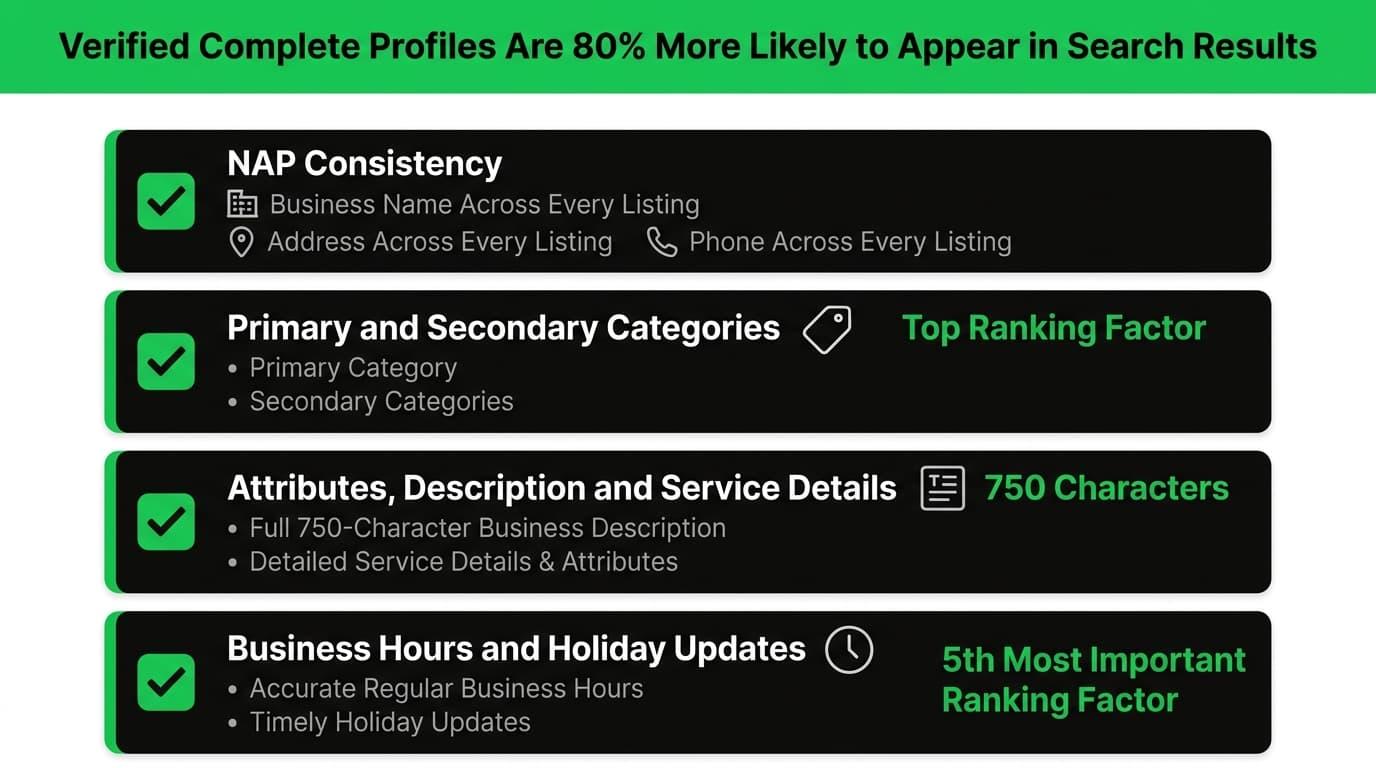
Birdeye’s State of GBP 2025 report found that verified, complete profiles are 80% more likely to appear in search results than incomplete ones, and Google prioritizes verified locations for rankings in local search results. Every empty field is a missed signal.
Here’s exactly what a complete, high-performing profile looks like.
1. NAP Consistency Across Every Listing
Your Name, Address, and Phone number (NAP) are Google’s primary trust signals. Google cross-references your NAP across every directory, your website, and third-party data sources. When anything mismatches, it creates what local SEO practitioners call citation noise, and your rankings absorb the damage.
- Citation signals account for 8% of Local Pack ranking weight. That’s enough to swing your position in a competitive market.
- Ensure your business name, address, and phone number match exactly across Google, your website, Yelp, Apple Maps, Facebook, and every directory where you appear, keeping business information consistent across listings and directories.
- Minor variations like “St.” vs. “Street” or a missing suite number are enough to weaken your signals. Fix them.
- Correct data aggregators first. Foursquare, Data Axle, and Neustar Localeze distribute your business data to hundreds of downstream directories, helping protect core business info from drifting across the web. Fix the source and corrections cascade within 4 to 12 weeks.
Inaccurate business information can weaken trust with search engines and customers alike.
2. Primary and Secondary Categories
The primary category is the single most important individual field in your GBP. The Whitespark 2026 survey confirmed it as the top factor influencing Local Pack rankings.
- Choose the most specific, accurate primary category available, not the broadest one that loosely fits.
- Add secondary categories to expand relevance for related services without diluting your primary signal.
- Revisit your categories periodically. Google regularly adds new, more specific options that may unlock additional visibility.
3. Attributes, Description, and Service Details
These three fields are incomplete on the majority of business listing profiles. That’s exactly why completing them is one of the fastest ways to gain a competitive advantage.
- Attributes such as wheelchair accessibility, free wi fi, or women-led status appear in search filters and directly affect click-through rates.
- Your 750-character business description should naturally include your primary keyword. Stuffing it triggers filters, not rankings.
- List every service as a distinct item so the profile can appear in relevant searches. A plumber who lists “water heater repair,” “emergency pipe burst,” and “drain cleaning” separately captures far more search queries than one with a generic description.
4. Business Hours and Holiday Updates
Being listed as open at the time of search is now the fifth most important Local Pack ranking factor. If your hours are wrong, outdated, or omit holiday closures, you’re losing visibility at the exact moments when searchers have the highest intent.
- Keep hours accurate at all times, and keep your website url and appointment links current wherever applicable. Update them for holidays, special events, and seasonal changes.
- Brick-and-mortar businesses see measurable ranking drops when listed as closed or temporarily closed. Audit this monthly at a minimum.
At SEOptimize, profile completeness is the first thing we fix before running any other local SEO tactic. We audit every field, clean up every inconsistency, and configure every setting correctly from the start. Getting this foundation right is what makes everything else work faster.
Google’s Three Local Ranking Factors and How Your Profile Affects Each One
Google evaluates every local listing across three dimensions: relevance, proximity, and prominence. A complete profile helps you rank higher in local search results. Each one connects directly to specific fields in your GBP, and understanding the connection is what makes optimization purposeful rather than guesswork.
| Factor | What Google Measures | GBP Fields That Drive It |
|---|---|---|
| Relevance | How well your profile matches the search query | Categories, description, services, Q&A content |
| Proximity | How close your business is to the searcher | Address accuracy, service area settings |
| Prominence | How well-known and trusted your business is online | Reviews, citations, web presence, posting activity |
Relevance: Does Your Profile Match What People Search For
Relevance is the most directly actionable factor. Every category, description line, service listing, and attribute you fill in tells Google what your business does and who it serves.
A profile with vague or incomplete fields loses relevance signals to competitors who filled every section with accurate, specific information. This is where the completeness checklist above pays off most immediately.
Proximity: What You Can and Cannot Control
Your physical address is fixed. But proximity is not entirely outside your control.
For service-area businesses, configuring your service area settings accurately tells Google which geographic searches your listing should surface for.
An incorrect or missing service area means you do not appear for searches in areas you actively serve, regardless of how well the rest of your profile is optimized, and this matters even more for businesses with multiple locations, where each service area or address setup must be configured correctly.
The SAB vs. storefront section later in this guide covers this configuration in full.
Prominence: How Reputation and Authority Are Measured
Prominence is where your google reviews strategy pays off as a core prominence signal. Whitespark’s 2026 data shows review signals now account for 20% of Local Pack ranking weight, up from 16% in 2023.
Review recency jumped from the 20th-most-important individual factor to the number one position in the same period. That’s the biggest single shift in the entire 2026 ranking factor study.
SEOptimize builds local strategies that simultaneously move all three ranking factors. We don’t just optimize your profile in isolation. We connect GBP work to your website, your citations, and your review velocity, so every lever compounds on the others and strengthens trust to improve search rankings.
Review Generation and Response as a Ranking Strategy
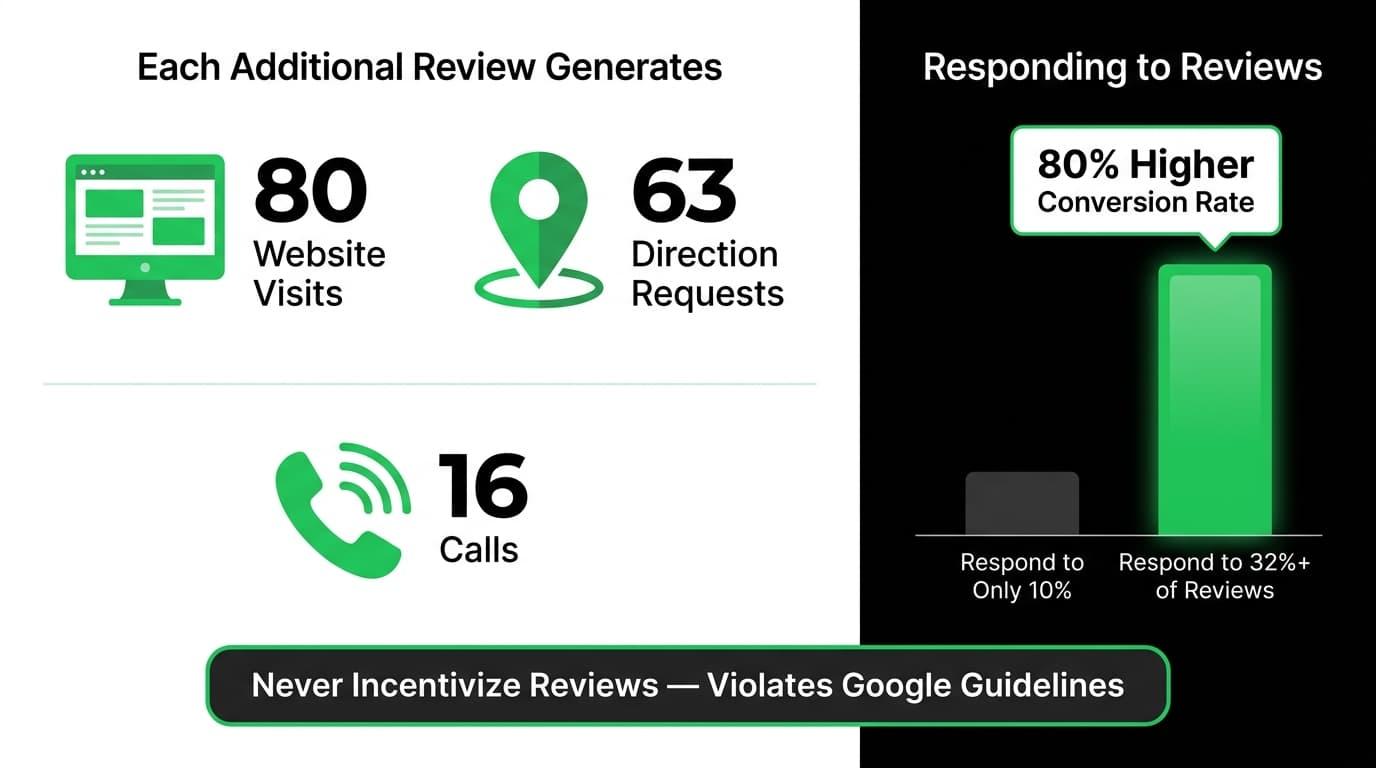
Reviews are no longer a reputation signal that feeds rankings on the side. In 2026, they are a primary driver of ranking, and stronger review activity can help convert more customers.
Birdeye’s 2025 research found that each additional review a business earns correlates with approximately 80 additional website visits, 63 direction requests, and 16 calls. That is revenue math, not a vanity metric. Too many businesses ignore review management until rankings drop, which is why consistency matters.
A profile with 12 reviews from three years ago signals neglect. A profile with a consistent stream of recent reviews signals an active, trusted business. The gap in rankings reflects exactly that.
How to Generate a Steady Stream of Reviews
The most common mistake: asking inconsistently, or not at all. The fix is systematic.
- Send a follow-up SMS or email within 24 hours of service completion asking for feedback from satisfied customers. Satisfaction is highest when the experience is fresh.
- Generate a direct review link from your GBP dashboard. Include it in email signatures, invoices, and service receipts. Fewer steps between the request and the review means a higher completion rate.
- Place a QR code that links directly to your review page. Put it at your front desk, on service vehicles, and on any printed materials customers take home.
- Train your team to make the ask a natural part of the job handoff and to invite happy customers to leave a review, not an awkward request tacked on at the end.
One hard boundary: Never incentivize reviews with discounts or gifts. This violates Google’s guidelines and can trigger mass review removal. Google’s August 2025 spam update specifically targeted inauthentic engagement signals.
Responding to Reviews: What Google Actually Notices
Responding to every Google review, positive and negative, signals active management to both Google and potential customers.
BrightLocal’s 2026 data found that businesses that respond to at least 32% of their reviews have an 80% higher conversion rate than competitors who respond to only 10%. That lift is measurable and consistent.
Two things responses do beyond rankings:
- Naturally, mentioning your service type or location in a reply gives Google additional relevant context about your business.
- A calm, professional response to negative reviews shows prospective customers how you operate under pressure. Ignoring negative feedback does the opposite.
SEOptimize builds review-generation systems that run automatically within your existing workflow. We set up the request sequences, generate your direct review links, and provide response frameworks so every review, positive or negative, works for you instead of against you.
Google Posts, Photos, and Videos: Signals That Show Google You Are Active
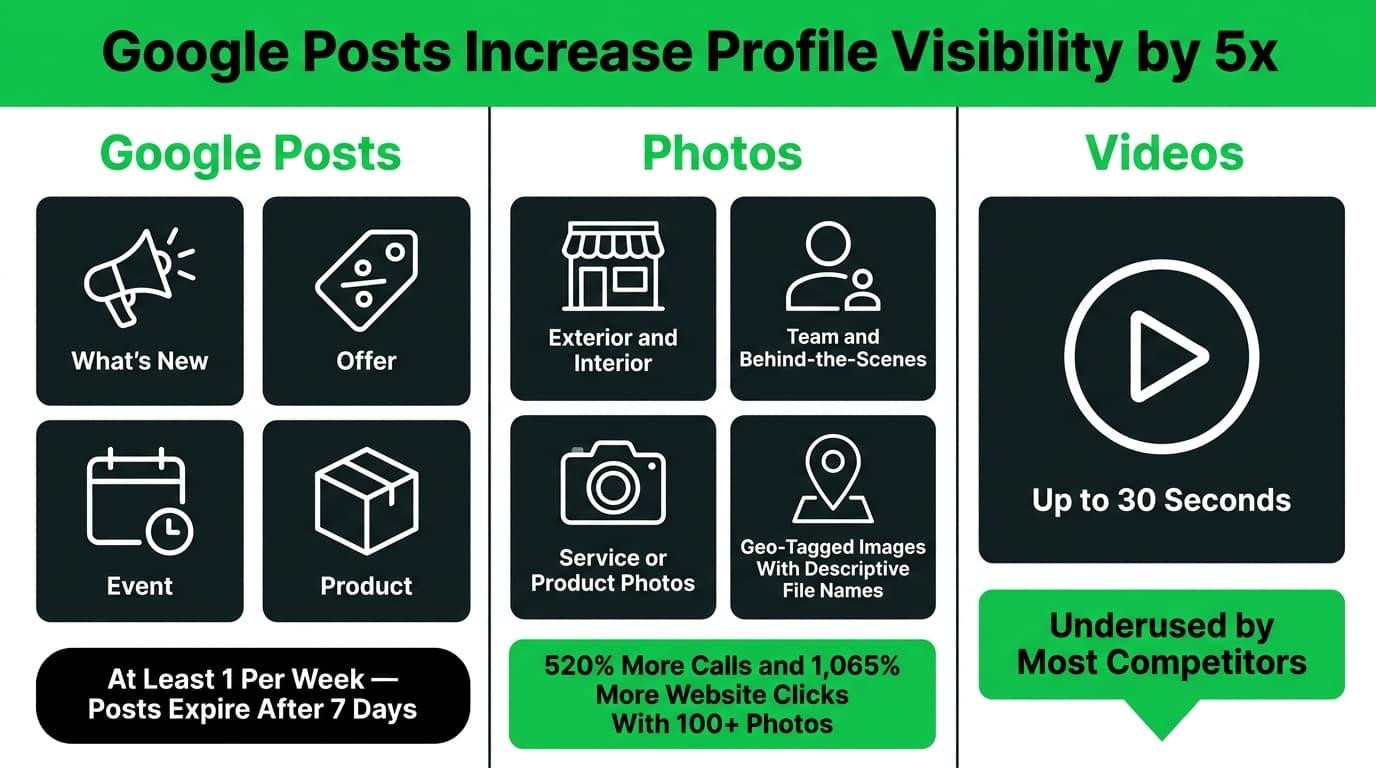
Most businesses set up their GBP once and walk away. Google notices, and active posting helps the profile surface in google search as well as Maps.
Posting activity, photo uploads, and video content are all interpreted as engagement signals. Regularly publishing Google Posts increases profile visibility by 5x, and user-generated photos add a local feel to business listings. Profiles that show consistent activity surface more prominently than profiles that sit untouched for months, and these activity signals support visibility across local search results. This isn’t an assumption; it’s a direct reflection of how behavioral signals feed into prominence scoring.
Google Posts: What to Publish and How Often
Google Posts appear directly on your profile in search results and Maps. Most post types expire after seven days, so a post from two weeks ago is already invisible to searchers and looks stale to Google. Regularly publishing Google Posts increases profile visibility by 5x.
That expiration window is the most overlooked detail in local content strategy.
Publish at least one post per week, but at minimum post regularly and at least once a month to stay relevant. Rotate between these types to match different search intents:
- What’s New: General updates, announcements, or seasonal messaging.
- Offer: Promotions with a defined start and end date. Google displays these as a countdown in some views.
- Event: In-person or virtual events tied to your business, including upcoming events.
- Product: Specific services or items with direct links back to your website.
Think of your post cadence as a publishing schedule, not a task to complete. Consistency over three to six months yields a more meaningful freshness signal than a burst of posts followed by silence. Posts also help incorporate fresh keywords into your profile.
Photos and Videos: Quality Over Quantity
Businesses with over 100 photos see 520% more calls and 1,065% more website clicks than those with minimal visual content. Adding videos visual content can also increase engagement on the profile.
Focus on these four categories first:
- Exterior and interior photos help searchers confirm they found the right place before they visit or call.
- Team and behind-the-scenes photos build trust before a prospect ever makes contact, and photos from local events can help when they reflect your business in the community.
- Service or product photos support conversion by showing exactly what customers can expect.
- Geo-tagged image files with descriptive file names reinforce local relevance signals at the file level.
User-generated photos add a local feel to the listing.
Short videos of up to 30 seconds remain underused by most local competitors. Even a few uploads give your profile a measurable engagement edge without requiring significant production effort.
SEOptimize handles post scheduling, photo recommendations, and video strategy as part of our ongoing local SEO management. We keep your profile active so it stays fresh in Google’s eyes every single week without adding anything to your plate.
Service Area Businesses vs. Storefronts: Optimization Is Not One-Size-Fits-All
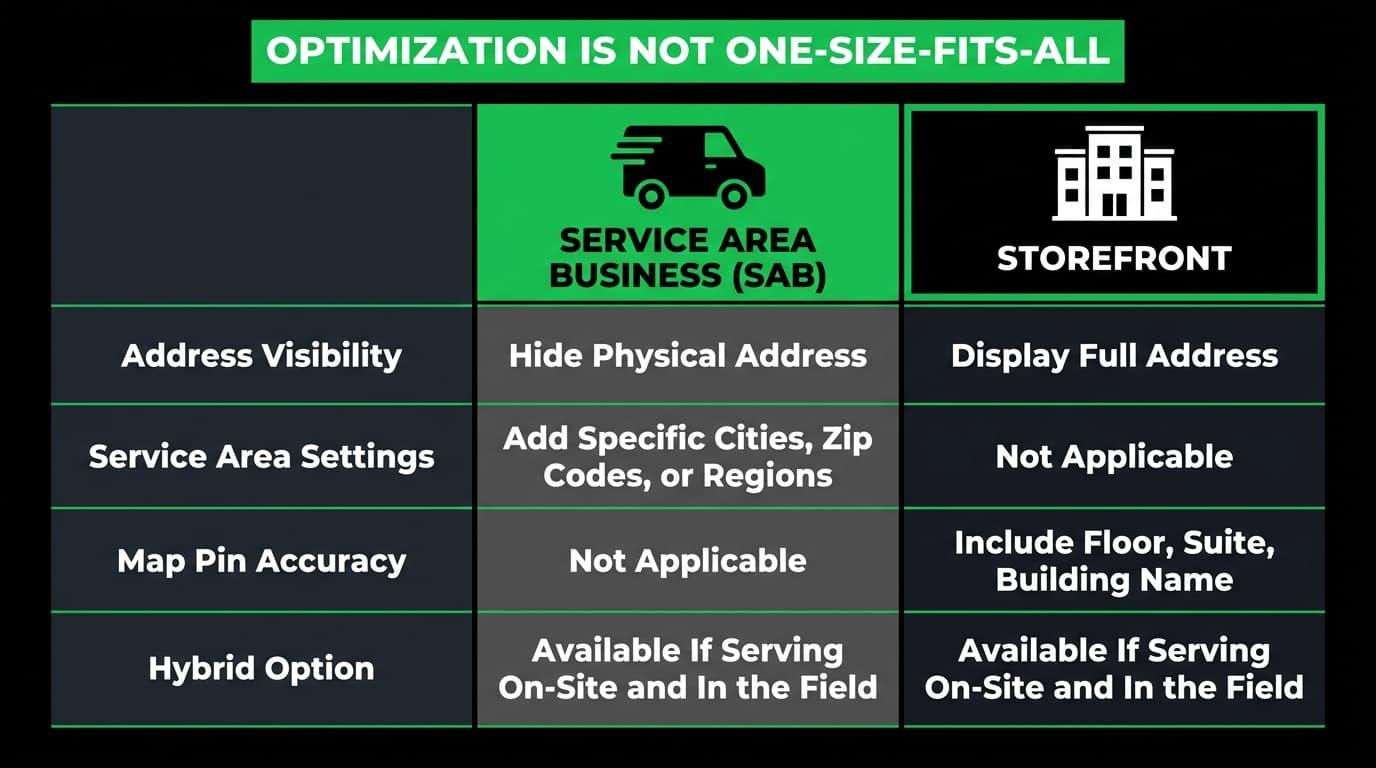
The configuration that works for a plumber who drives to job sites is structurally different from that of a dental office with a waiting room. Using the wrong setup doesn’t just leave performance on the table. It can actively suppress your local search visibility.
Optimizing a Service Area Business (SAB) Profile
SABs should hide their physical address if they do not serve customers at that location. Leaving a non-customer-facing address visible creates confusion for Google and erodes credibility with searchers who try to navigate there.
- Define your reach by adding specific cities, zip codes, or regions as service areas.
- Be precise. Vague or overly broad service area settings dilute your relevance for the specific searches that convert.
- A well-configured SAB tells Google exactly where you operate, which directly improves how your listing surfaces in Maps for those locations.
Storefront-Specific Settings SABs Should Not Use
Physical storefronts should display their full address and verify it with precision. Floor numbers, suite details, and building names all affect map pin accuracy.
Skipping these details can send customers to the wrong entrance or create mapping data that confuses Google’s verification process.
Hybrid business? If you serve customers both on-site and in the field, Google has a specific hybrid configuration option. Using it correctly avoids NAP conflicts across directories and keeps your local signals clean.
Whether you run a storefront, an SAB, or a hybrid operation, SEOptimize configures your profile to match the setup that best fits your business. We handle the service area settings, address visibility, and category configuration so your listing surfaces in the right searches and not the wrong ones.
Get My Profile Configured Correctly
Suspension Risks and Google’s Automated Edits: What Most Businesses Miss
Most businesses discover their profile has been suspended after calls stop coming in. By then, the damage is done, and the reinstatement process is rarely quick.
Understanding what triggers suspensions and how Google’s automated editing system works is essential for keeping the visibility you have built.
Common Actions That Trigger a GBP Suspension
- Keyword stuffing in your business name. Adding your city or service type to a name that doesn’t legally include it. Google’s AI now detects this and applies penalties.
- An address mismatch. Your listed address does not match what Google can verify through third-party sources.
- Operating in a high-risk category. Some categories trigger automatic reviews, even for legitimate businesses.
- Duplicate listings. Even unintentional ones, such as a listing set up by a previous owner or employee years ago.
How Google’s Automated Edits Work and How to Catch Them
This is the part most businesses never see coming.
Google algorithmically edits GBP fields, including your business name, hours, address, categories, and linked social media accounts, based on third-party data sources and user-submitted suggestions. These changes go live immediately. You get a notification, but if you’re not watching, the edit has already affected your profile.
What makes profiles more vulnerable:
- Weak NAP consistency across directories. When Google sees conflicting signals, it treats the inconsistency as an invitation to “correct” your data. If those third-party sources are incorrect, your profile is updated to reflect the incorrect information.
- Not monitoring your profile. Unauthorized edits compound silently over weeks before most business owners notice.
The fix is straightforward:
- Enable Google Business Profile notifications in your account settings.
- Check your profile manually at least once per week.
- Keep your citations consistent so Google has less reason to overwrite your business info.
Tracking GBP Performance: The Metrics That Actually Tell You Something
Knowing which actions to take is only half the equation. Knowing whether those actions are working is what separates businesses that grow over time from those that optimize once and wonder why nothing changed.
GBP Insights gives you the data. But not all metrics carry equal weight in 2026.
| Metric | What It Measures | How to Use It |
| Discovery impressions | Profile views from non-branded searches | Tracks Local Pack visibility growth over time |
| Direct impressions | Profile views from branded searches | Reflects existing brand awareness levels |
| Direction requests | Users navigating to your location | High-intent proxy for foot traffic volume |
| Call clicks | Users tapping your phone number | High-intent proxy for lead volume |
| Photo views vs. competitor average | Visual content engagement gap | Shows whether your photo strategy needs attention |
Track calls and direction requests weekly. These action-based metrics are your best real-world proxy for what your profile is generating.
As covered earlier in this guide, AI Overviews have decoupled impressions from actions for many businesses. Local search data from 2025 to 2026 confirms that flat action data after an impressions drop is not a red flag. It means Google is filtering for intent before users even reach your profile, and those who do reach it are ready to act.
Review GBP performance on a monthly cadence at a minimum. Trends across four to six weeks tell a real story. Single-week snapshots in isolation do not.
GBP Optimization as Part of a Broader Local SEO Strategy
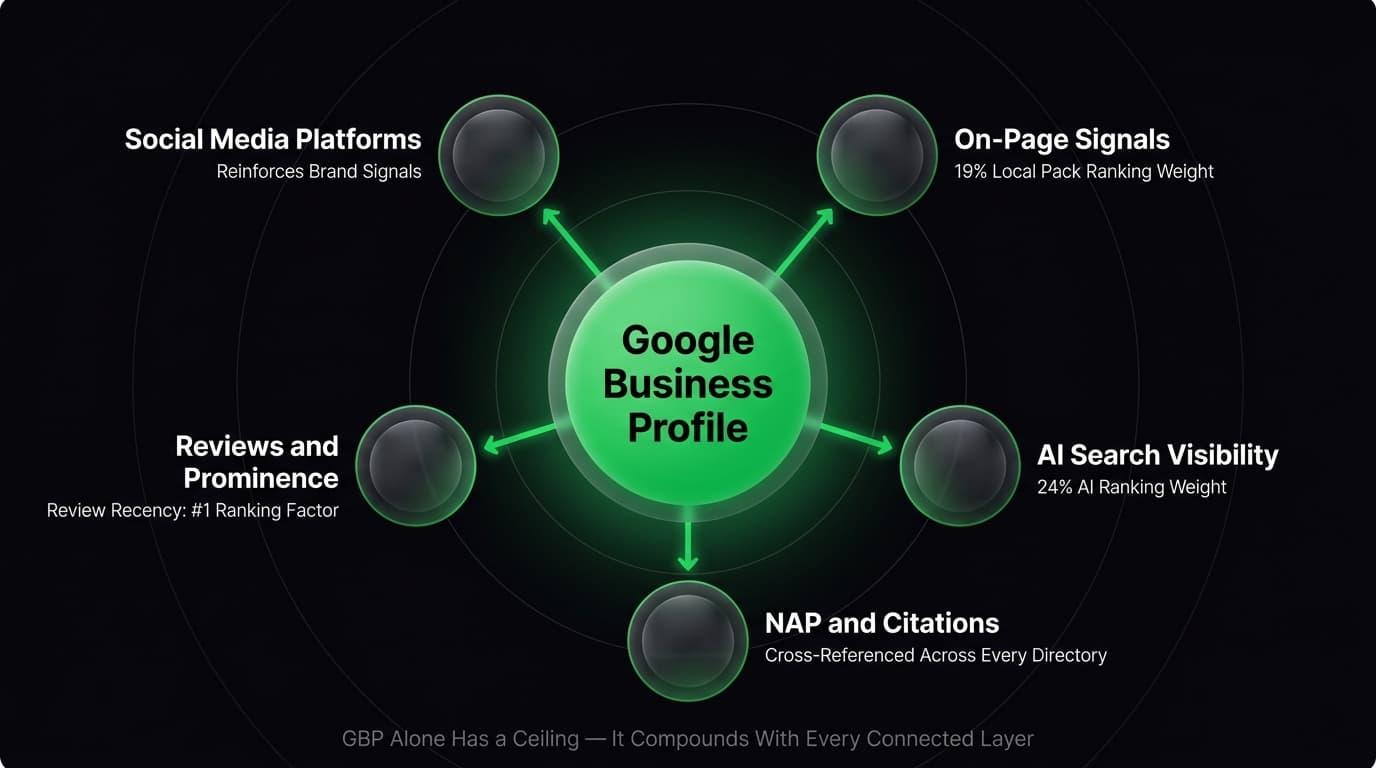
A well-optimized Google Business Profile is the highest-impact single action you can take for local visibility across Google and other search engines, but it has a ceiling when treated in isolation.
Businesses that plateau fastest are usually the ones running GBP as a standalone tactic rather than integrating it into a full local SEO strategy.
Here’s how the full ecosystem connects:
- On-page signals now account for 19% of Local Pack ranking weight. Localized content, local landing pages, and schema markup on your website feed into prominence, the same ranking factor that your reviews and citations influence.
- For AI search visibility specifically, on-page signals account for 24% of AI ranking weight, making your website content directly responsible for how you appear in AI-generated local results.
- NAP consistency ties everything together. Google cross-references your business data across every directory against your GBP. Inconsistencies weaken the trust signals your entire local presence depends on, and matching details across review sites supports the same trust signals as citations. Consistency across social media platforms can also reinforce brand signals.
Profile optimization opens the door. A complete local search ecosystem keeps it open.
[CEO QUOTE PLACEMENT] “Share your perspective on why most local SEO agencies stop at the GBP and never build the surrounding ecosystem, and what that gap costs clients over time. Explain how SEOptimize approaches the full picture differently from day one.” —Nathan Smith, Founder, SEOptimize
Final Words
Google Business Profile optimization remains the single highest-return action a local business can take in 2026.
Every item in this checklist compounds. Profile completeness, consistent reviews, active posts, correct configuration, and performance tracking all work together to build visibility that holds under pressure.
Treating any one piece in isolation limits what the others can do. The businesses dominating local search in 2026 did not find a shortcut. They built every layer and kept maintaining it.
At SEOptimize, we help local service businesses build a local SEO strategy that turns Google into a consistent, predictable lead source. If you want to know exactly where your profile stands and what it will take to rank where your customers are searching, reach out.
We’ll show you what’s working, what isn’t, and what to fix first.
Get My Free Local SEO Consultation
Frequently Asked Questions
Still have questions about optimizing your Google Business Profile in 2026? Here are straightforward answers to what local businesses ask most.
How long does it take to see results from GBP optimization?
Results from GBP optimization typically begin showing within 30 to 90 days. The timeline depends on your market’s competitiveness, how incomplete your profile was before, and whether you are building review velocity alongside the profile changes. In less competitive markets, meaningful ranking movement can occur within 2 to 4 weeks.
Does my website affect my Google Business Profile rankings?
Yes. On-page signals account for 19% of Local Pack ranking weight. Google cross-references your website’s NAP data, local keywords, and domain authority against your profile. A weak or inconsistent website actively holds your GBP back, regardless of how well-optimized the profile itself is.
How many reviews do I need to rank in the Local Pack?
Localo’s analysis of over 2 million profiles found that businesses ranking in positions 1-3 typically have around 240 reviews. More important than total count is recency. Whitespark’s 2026 data ranked review recency as the single most important individual ranking factor. Ten reviews from the past 30 days outweigh 100 reviews from three years ago.
Can Google change my business profile without my permission?
Yes. Google algorithmically edits GBP fields, including your name, hours, address, and categories, based on third-party data and user-submitted suggestions, so gain access to your profile dashboard to monitor and correct edits quickly. Changes go live immediately. Enable profile notifications in your GBP settings and audit your profile weekly. Strong NAP consistency across all directories also reduces the frequency with which Google “corrects” your data.
What’s the difference between a soft suspension and a hard suspension?
A soft suspension hides your profile from search results, cutting off visibility in local search results and relevant searches, without deleting it. A hard suspension removes the profile entirely and requires a formal reinstatement request. Both are triggered by the same violations: keyword stuffing in your business name, address mismatches, and duplicate listings. Reinstatement for either can take days to weeks, which is why prevention matters far more than knowing how to recover.