
When a homeowner’s basement is flooding at 9 PM, they aren’t scrolling past the first three plumbers they see on Google. They’re calling the one with 180 reviews and a 4.9-star rating, and they’re doing so fast.
The same thing happens when a family needs a roofer after a storm, an HVAC company before a heat wave, or an electrician to sort a tripped breaker before a holiday weekend.
In every one of those situations, the business with the stronger Google review profile wins the call before anyone else even gets a chance.
At SEOptimize, we work with local service businesses across plumbing, HVAC, electrical, roofing, landscaping, pest control, cleaning, home renovation, and more. The single most consistent gap we see isn’t the quality of their work, but the absence of a system to turn satisfied customers into published reviews, especially since 70% of customers will leave a review if asked.
This guide gives you that system, including what Google explicitly prohibits in 2026, the timing strategies that get the highest response rates, and how to respond to every review in a way that converts new customers.
Key Takeaways
- Google reviews directly impact your Local Pack ranking through quantity, star rating, and recency across every home service trade.
- Businesses that respond to every review see a 16.4% higher conversion rate according to SOCi research.
- The ideal review request window is within 24 hours of job completion, whether that job was a drain unclogging, a roof inspection, or a seasonal lawn treatment.
- Google’s 2026 policy update bans on-site kiosks, staff review quotas, and any form of incentivized reviews.
- A short, direct review link is the single biggest friction reducer in your entire outreach strategy.
- SMS open rates are roughly 90%, compared to about 20% for email, per Gartner. For trades businesses with mobile-first customers, that gap matters.
- One polite follow-up reminder is allowed. Anything beyond that crosses Google’s policy line.
Why Google Reviews Directly Affect Your Revenue and Local Rankings
For local service businesses, the Google Local Pack is the most valuable piece of digital real estate available.
It’s the three-business block that dominates the top of local search results before anyone scrolls further, and it captures the majority of clicks for high-intent searches like “plumber near me,” “HVAC repair,” “pest control this week,” or “roofer after storm damage.”
Reviews aren’t just social proof in that space; positive google reviews directly shape trust and act as a ranking signal Google uses to decide who shows up at all.
How Reviews Influence the Google Local Pack
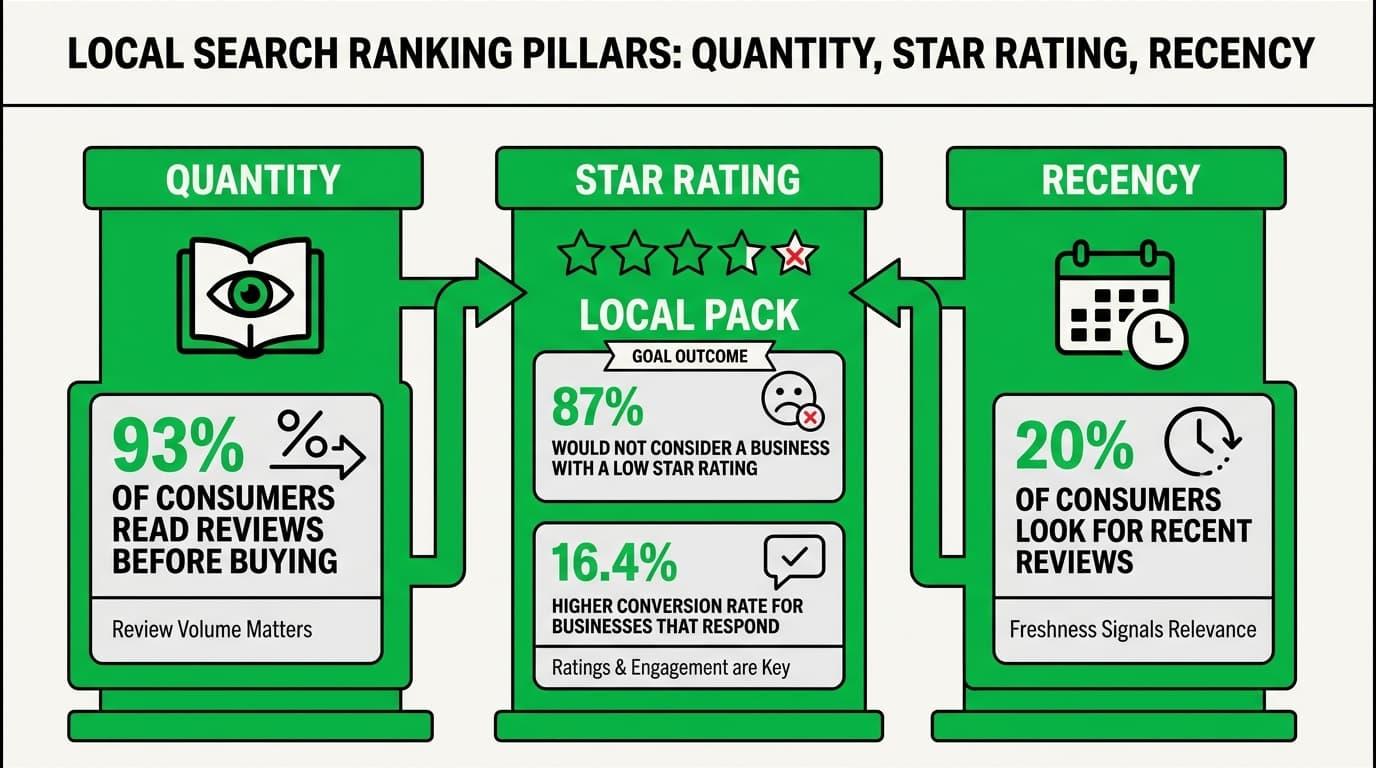
Google evaluates three review-related factors when ranking local businesses:
- Quantity
- Star rating
- Recency
A plumbing company with 210 reviews and a 4.8-star rating will consistently outrank a competitor with 35 reviews and a 4.1, all else being equal. The same dynamic plays out for every trade. An electrician with 150 reviews who gets two or three new ones every week will outperform a well-established HVAC company that stopped collecting reviews two years ago. Whitespark’s Local Search Ranking Factors report has ranked reviews among the top Local Pack signals consistently for years.
93% of consumers read reviews online before buying a product, and 87% say they would not consider a business with a low star rating. For trades and home services, that number carries even more weight because the jobs are high-stakes.
A homeowner choosing between three roofers isn’t just comparing prices. They’re looking for evidence that someone else trusted you with their home and wasn’t disappointed.
The revenue connection is direct. Businesses that respond to all their reviews see a 16.4% higher conversion rate compared to those that ignore them, according to SOCi research, and more google business reviews can also drive more leads. For a landscaping company or a cleaning service that runs on repeat bookings, that conversion lift compounds quickly.
Why Recency Is More Important Than You Think
Here’s a scenario that plays out every month in competitive local markets.
A pest control company has earned 300 reviews over the past 6 years. A newer competitor has 80 reviews, collected consistently over the past six months. In many cases, the newer competitor ranks higher because Google weights recent activity. Recency is one of the most underweighted review signals among business owners who obsess over total count but let weeks pass without a single new review. 20% of consumers look for recent reviews before trusting a business.
For seasonal businesses like landscaping and roofing, this is especially important. A lawn care company that collects reviews every spring and summer stays visible. One that collects a batch in April and then nothing until October is giving ground to competitors every single month in between.
[CEO QUOTE: Share your take on why most local service businesses have a review problem that is really a systems problem, not a satisfaction problem. Example angle: Most of the plumbers, roofers, and HVAC techs we work with are doing genuinely great work. Their customers are happy. The problem is they never built the habit of asking. That one gap costs them more Google visibility than almost anything else we see.]” — Nathan Smith, Founder of SEOptimize
Make Sure Your Google Business Profile Is Ready to Collect Reviews
Before you send a single review request, your Google Business Profile needs to be fully set up and verified. If it isn’t, the reviews your customers leave may not appear publicly or may get delayed and buried. That’s wasted effort on both sides, and for a plumber or electrician running lean, that waste adds up.
Claim, Verify, and Optimize First
Many business owners still search for Google My Business, which is the old platform name. Google fully rebranded it to Google Business Profile. Same platform, different name. Once verified, fill out every field before you start asking for reviews, including your business name, address, and contact information. Google’s own profile guidelines are clear that complete, active profiles rank higher and are treated as more credible.
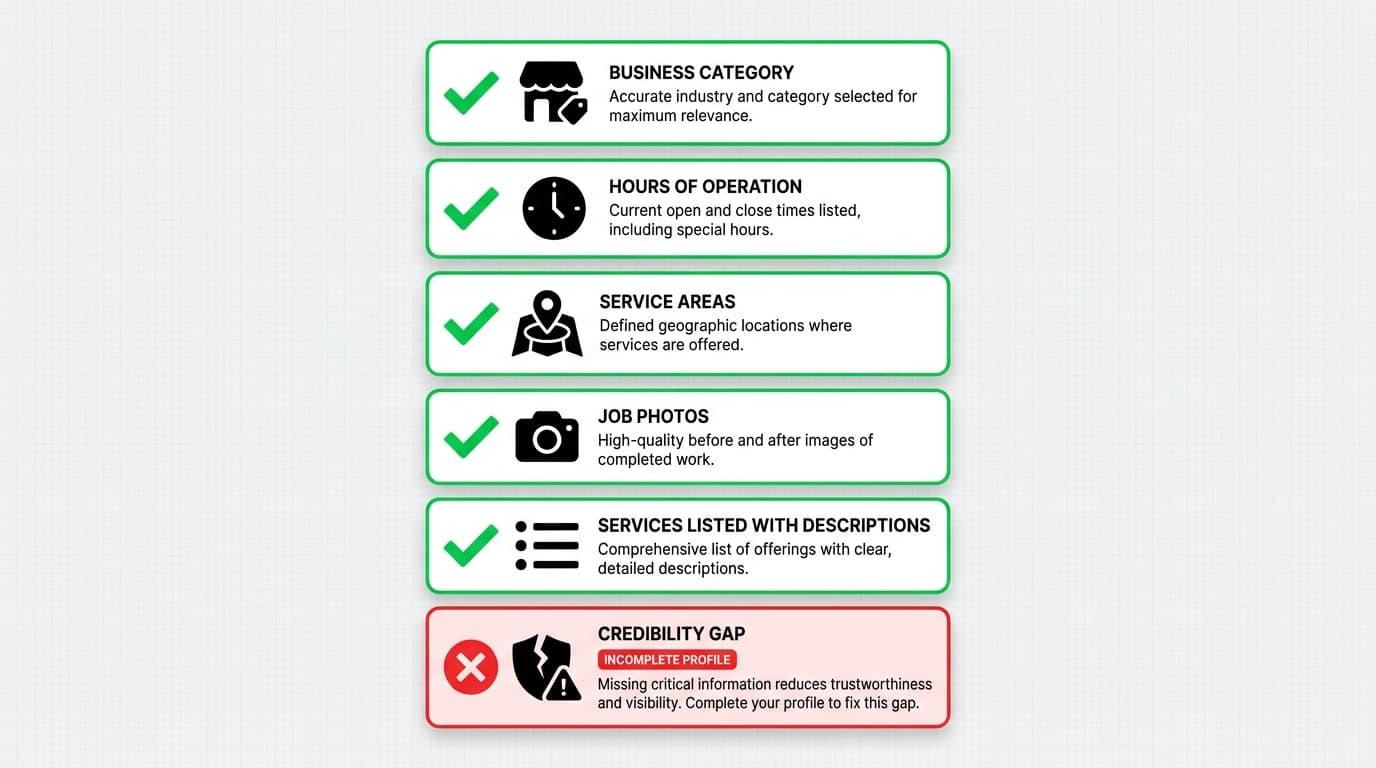
Here is what a fully optimized profile needs across every trade before you begin your review campaign:
- Business category set to your specific trade (“plumber,” “HVAC contractor,” “licensed electrician,” “roofing contractor” all outperform the generic “contractor”)
- Hours of operation, including emergency availability, which matters especially for plumbing and electrical work
- Service areas listed accurately, particularly for businesses like landscaping, pest control, and cleaning that work across multiple neighborhoods or zip codes
- Photos of completed jobs: finished bathroom plumbing, a clean AC unit install, a freshly sodded lawn, a patched roof, a pest-free crawl space after treatment
- Services listed clearly with descriptions: drain cleaning, circuit breaker replacement, exterior painting, quarterly pest treatment, gutter cleaning, and so on
An incomplete profile creates a credibility gap. A homeowner reads a five-star review about your electrical panel replacement, clicks to your listing, and finds no photos, incomplete hours, and a category that just says “contractor.” That gap costs you the call even when your reviews are strong.
Create Your Google Review Link and Make It Frictionless
Your review link is the single most important asset in your entire review strategy.
Without it, you’re asking a customer who just had their HVAC system serviced, their kitchen repiped, or their lawn aerated to search for you on Google on their own.
Most won’t follow through, not because they’re unhappy, but because the extra step is just enough friction to stop the action.
How to Find and Shorten Your Review Link
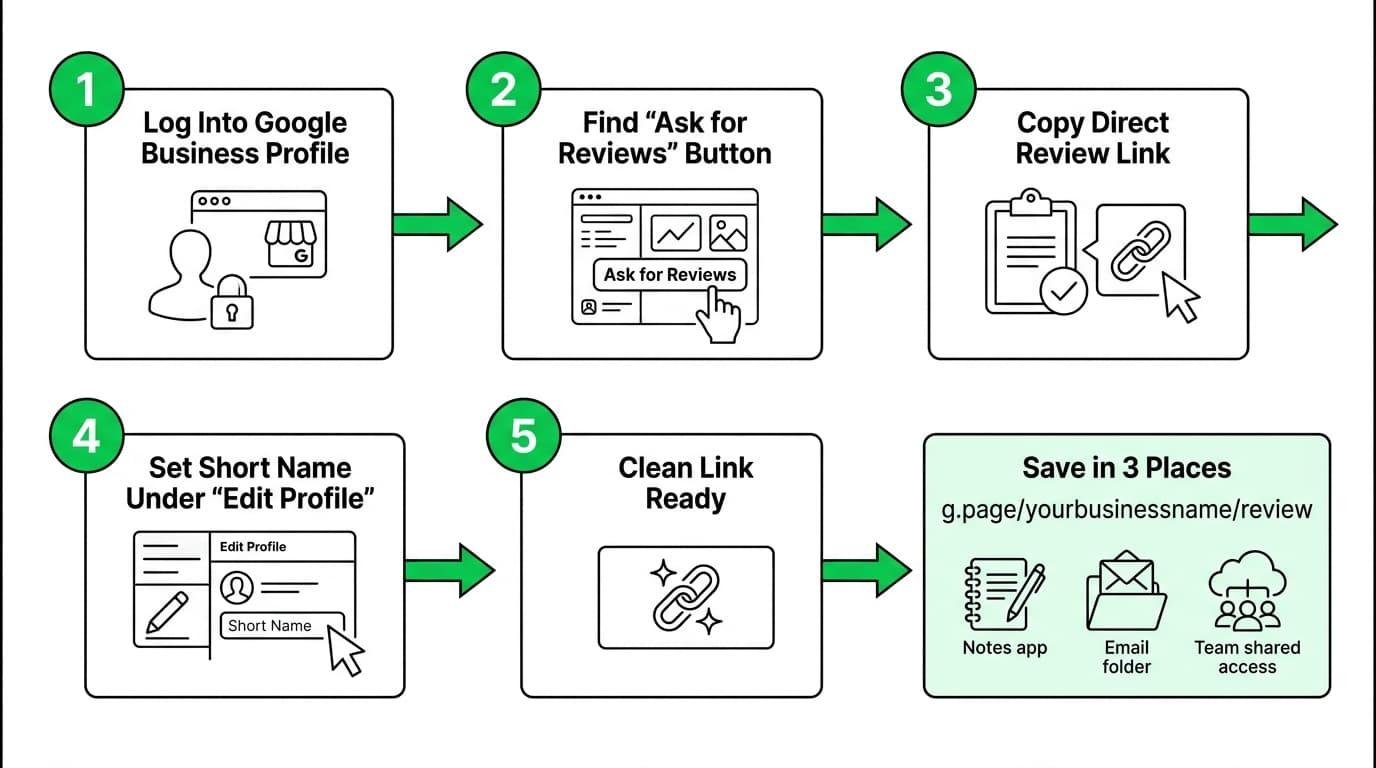
- Log into your Google Business Profile dashboard.
- Find the “Ask for reviews” button on your home screen.
- Click it, then copy the direct review link it generates.
- Set a short name for your profile under “Edit profile” to further shorten the link.
- Your clean link will look like: g.page/yourbusinessname/review
Once you have your link, save it in three places: your notes app, your email draft folder, and a shared location your team can access from the field. The Google Marketing Kit also lets you download printed materials featuring your link, which works well on invoices, job completion sheets, or door hangers left after a pest treatment or lawn service.
A long, scrambled URL creates hesitation and measurably lowers review conversion. A short, clean link removes that barrier. For a cleaning crew finishing a move-out job or a roofer handing over a completion sheet, that difference between a clean link and a 90-character URL is the difference between a good review and a missed opportunity. A short explainer video showing customers exactly how to leave a review can also help less tech-savvy users follow through.
How to Ask for Google Reviews Across Every Channel
Most business owners in plumbing, HVAC, roofing, and other trades occasionally ask for reviews.
After an especially smooth job, when a customer happens to express gratitude at the door, or when someone on the team remembers to mention it.
While that might work on occasion, that’s not a system. A real system means every satisfied customer gets a request through the right channel at the right time, whether you’re on the job or not.
Email Campaigns and Signatures
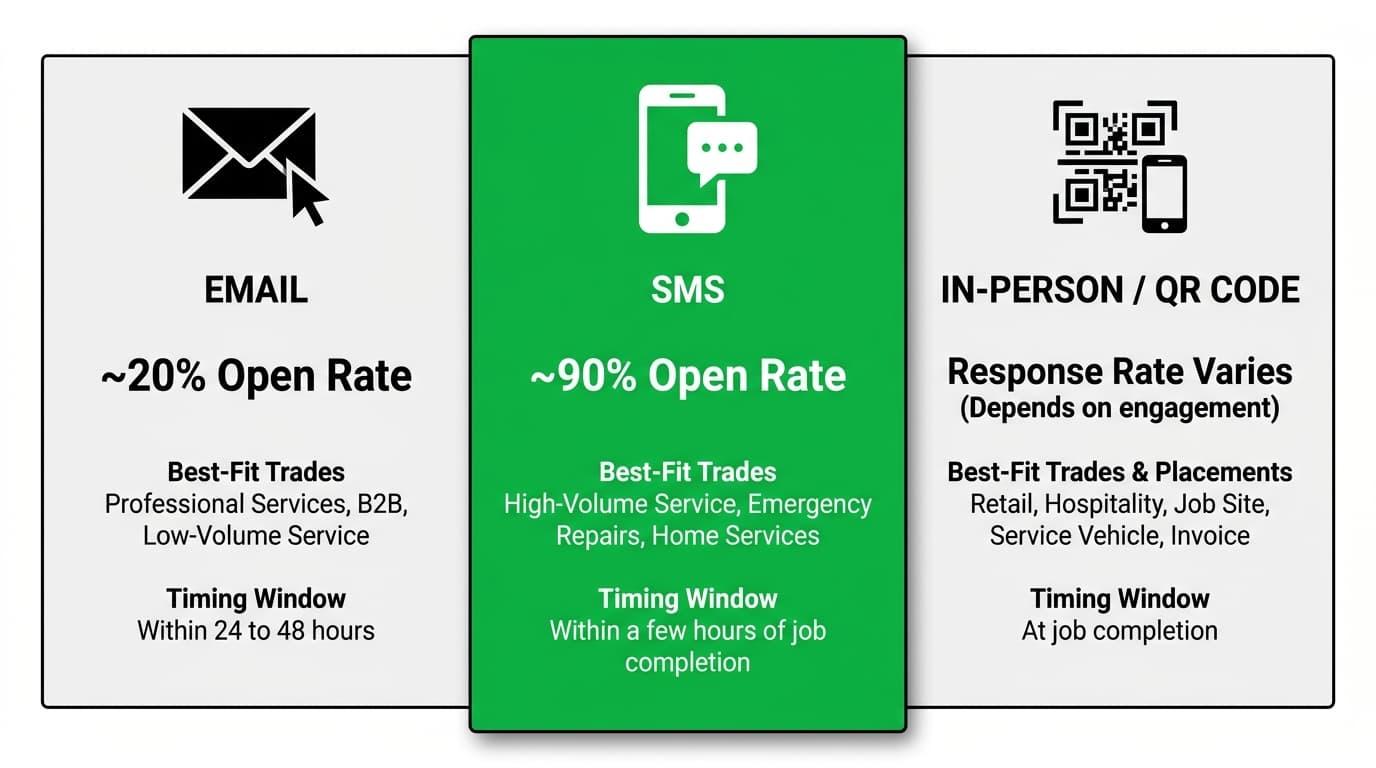
Email works well for trade businesses that send digital invoices or job completion summaries, including most cleaning services, pest control companies, landscaping businesses, and home renovation contractors.
Send your review request in the same email thread as the invoice, or as a separate message within 24 to 48 hours of job completion. With average email open rates around 21%, your subject line matters.
“Quick favor after your lawn service today” or “How did we do on your roof inspection?” will outperform anything generic.
Keep the request itself short. One paragraph, one link, one ask:
“Hi [Name], it was great working with you today. If you have 60 seconds, a Google review would mean a lot to us. Here is the direct link: [your review link]. Thank you.” — Review Request Email Template
Your email signature is a passive but always-on channel. Add a line like “Happy with our work? Leave us a Google review” to every outgoing email from every team member. Every invoice, every follow-up, every seasonal reminder from your landscaping or pest control company becomes a low-friction review touchpoint. Your company website can also host the same review prompt and direct link.
SMS Review Requests
SMS open rates run at approximately 90% compared to roughly 20% for email. For plumbers, electricians, and HVAC techs, customers are almost always on mobile when they book and pay, making SMS the higher-converting channel by a wide margin. Keep the message under three sentences:
“Hi [Name], thanks for choosing us for your [job type] today! If you are happy with the work, a quick Google review would really help us out: [short link]. It only takes a minute.” — SMS Review Request Template
In practice, that message for a plumbing company would read:
“Thanks for choosing us for your water heater replacement today.”
For a pest control company:
“Thanks for letting us treat your home for termites this morning.”
That specificity signals to the customer that the message is personal, not automated, even when it is sent from a CRM.
Review request response rates drop measurably when messages are sent more than 24 hours after service. For emergency trades like plumbing and electrical, send within a few hours of job completion. For scheduled services like quarterly pest control, lawn maintenance, or cleaning, send them the same afternoon or evening.
In-Person Requests and QR Codes
The in-person ask is still the most effective method when it happens at the right moment.
Train every technician, crew lead, and field rep to make the ask naturally at job completion. Not as a script, but as a genuine close to the conversation.
Here’s how it sounds across different trades:
- Plumber finishing a pipe repair: “Everything is sealed and dry. If you’re happy with how it went, a Google review helps us a lot.”
- HVAC tech completing a tune-up: “Your system is running clean. If the service was good, we would really appreciate a quick Google review.”
- Roofer wrapping a shingle replacement: “You’re all set before the rain comes. If you’re satisfied, a review on Google would mean a lot to the team.”
- Electrician after a panel upgrade: “Everything is up to code and labeled. If the job went smoothly for you, a Google review is the best way to say thanks.”
- Pest control tech finishing a treatment: “The perimeter is treated and you should see results within a few days. A Google review would really help our small business.”
- Landscaping crew leads after a seasonal cleanup: “Your yard is ready for the season. If you’re happy with the work, we would love a Google review.”
- Cleaning crew finishing a deep clean or move-out: “The place is spotless. If everything looks good to you, a quick Google review would mean a lot to us.”
- Home renovation contractor at project handoff: “Walk through it and let us know if anything needs adjusting. If you love how it turned out, a Google review is the best way to help us grow.”
QR codes make the follow-through effortless. Print them on invoices, job completion sheets, business cards, van wraps, yard signs left after a landscaping or roofing job, and door hangers distributed after a pest control treatment. Each code links directly to your review page. Scan and done, no searching required.
When to Ask: Timing That Gets More Responses
Timing a review request poorly is almost as bad as not sending one at all.
Send too early, before the customer has had a chance to assess the work, and you risk a lukewarm response.
Sending too late, after the experience has faded, and you lose the emotional peak of satisfaction. The goal is to catch the customer at exactly the right moment.
Customers who leave reviews most often do so within one day of the experience. For most home service trades, here is what that looks like in practice:
| Trade or Service | Best Timing Window | Recommended Channel |
|---|---|---|
| Plumbing (emergency or scheduled) | Within 2 to 4 hours of job completion | SMS |
| HVAC (repair or seasonal tune-up) | Same day, within 4 to 6 hours | SMS or email |
| Electrical (repair or installation) | Within 2 to 4 hours of completion | SMS |
| Roofing (repair or full replacement) | Day of completion or the following morning | Email with photos |
| Landscaping or lawn care | Same afternoon or evening as the service | SMS |
| Pest control (one-time or recurring) | Within a few hours of treatment | SMS |
| Cleaning services (regular or move-out) | Within 1 to 2 hours of crew departure | SMS |
| Home renovation or general contracting | At the project handoff walkthrough | In-person plus email follow-up |
Beyond trade-specific timing, a few universal rules apply across all of them:
- Never send a review request when there’s an open complaint or unresolved punch list item. A roofing customer who has flagged a leak or a renovation client waiting on a missing fixture isn’t in the right headspace. Resolve the issue first.
- One follow-up reminder is acceptable if you get no response after the first request. Sending a second reminder three to five days later is within policy. Sending a third crosses into pressure territory.
- Don’t batch-send review requests to multiple customers at once. A pest control company that completes 10 jobs on Friday and sends all 10 review requests Friday evening may appear automated to Google and trigger spam filters.
- Personalize wherever possible. “Hi Sarah, glad we could get your AC back on before the weekend” will outperform “Dear valued customer” every single time, regardless of the trade.
What Google’s 2026 Review Policy Actually Prohibits
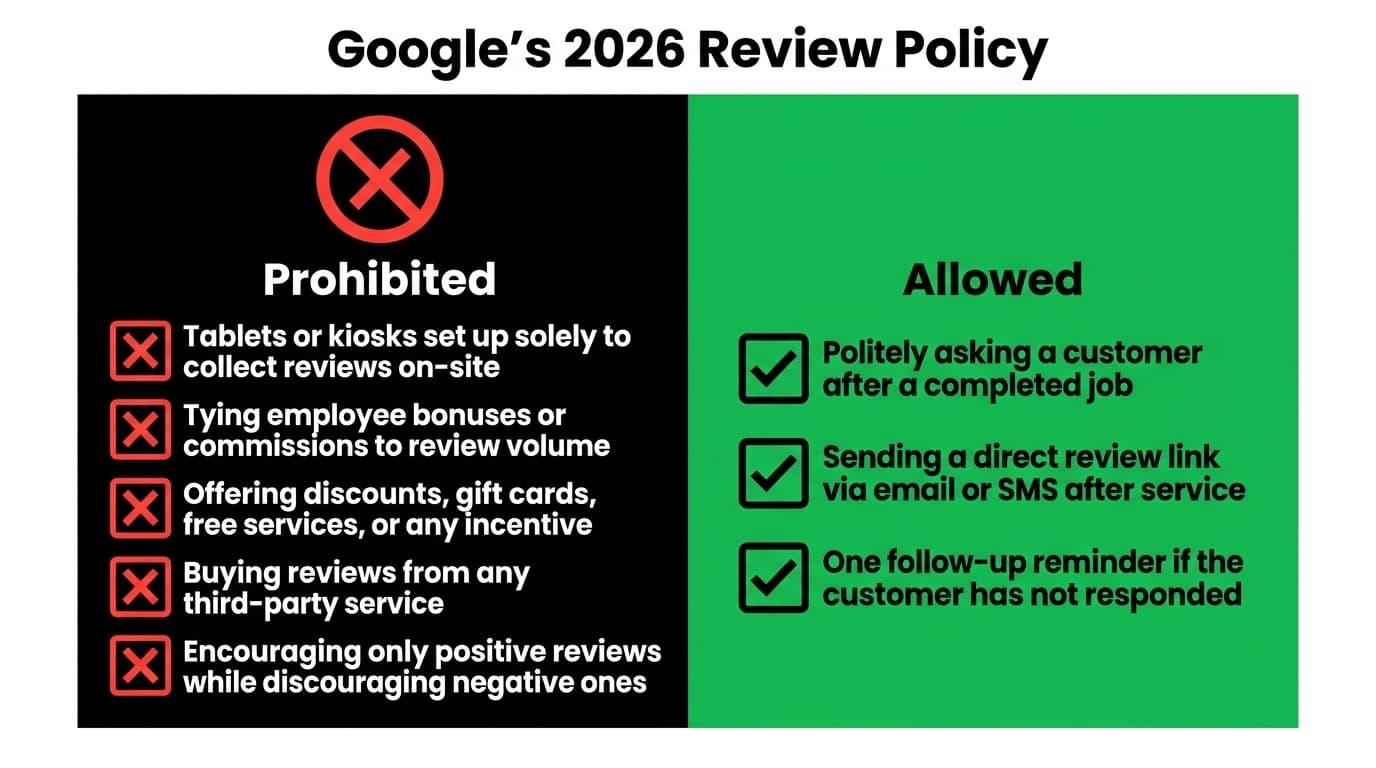
Google significantly tightened its review solicitation policy in 2026, and several tactics local service businesses have used for years are now explicitly prohibited.
Before you build your outreach system, you need to know exactly where the line is. The consequences for crossing it are real.
New Rules on Kiosks, On-Site Pressure, and Review Quotas
The 2026 update goes well beyond the obvious “no fake reviews” rule. Below is a breakdown of what Google now explicitly allows and prohibits for local service businesses:
A few of these deserve specific attention for home service trades. The kiosk rule catches out HVAC and pest control companies that set up tablets in their office or service vehicles for customers to review on the spot.
The quota rule affects roofing and home renovation companies that run sales teams and have tried to tie review counts to performance bonuses. Both are now explicitly prohibited.
The line is clear: Asking is fine, pressuring is not. Any tactic that creates urgency, obligation, or reward around leaving a review crosses into prohibited territory on your Google Business Profile.
The Real Cost of Violations: Suspensions and Fines
Tens of thousands of businesses had reviews removed or their profiles suspended for policy violations in 2025 alone. For a plumbing company or a landscaping business that depends on Local Pack visibility for the majority of its inbound leads, a profile suspension is not just an inconvenience. It’s a revenue emergency.
The FTC adds another layer. The FTC’s rule banning fake reviews and testimonials means businesses running undisclosed, incentivized review campaigns can face federal fines in addition to Google penalties. A cleaning company that offers a discount in exchange for a five-star review is not just risking its Google profile. It is risking a federal enforcement action.
Note: Every review strategy we build for clients at SEOptimize is designed to be fully compliant with both Google policy and FTC guidelines. A shortcut that earns 20 reviews this month and gets your profile suspended next month isn’t a strategy; it’s a liability.
Respond to Every Review, Positive and Negative
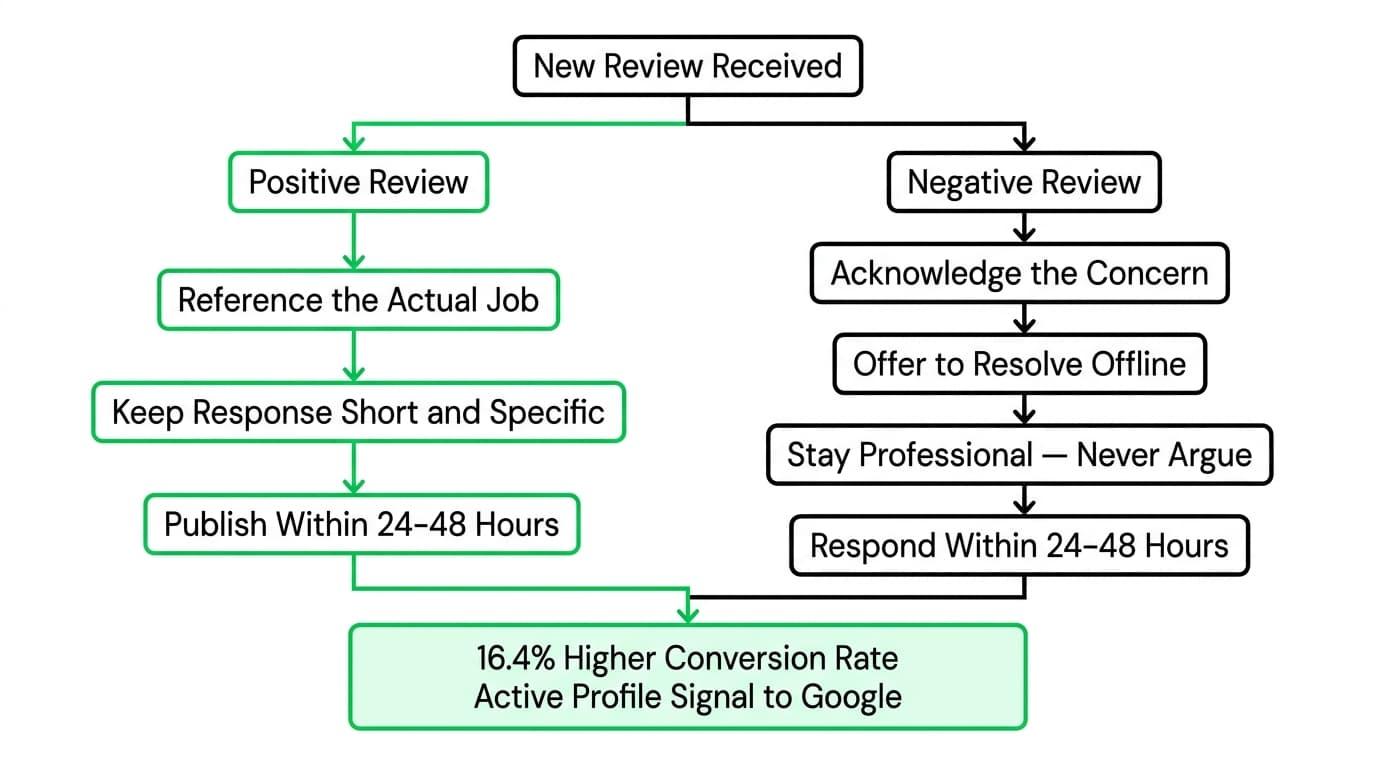
Most local service business owners focus entirely on collecting reviews. Far fewer think carefully about what happens after the review lands. That gap is directly costing them conversions, and it is one of the fastest fixes available in local SEO.
Businesses that respond to all their reviews see a 16.4% higher conversion rate compared to those that do not respond at all, and 53% of customers expect a response within a week. Responding also signals active profile management to Google, a positive local ranking signal that contributes to how your listing performs in the Local Pack.
How to Respond to Positive Reviews
Keep responses short and specific. A boilerplate “Thanks for the five stars!” is better than nothing, but a response that references the actual job builds far more trust with future customers who are reading your reviews. Let’s look at what that means across trades:
- For plumbing: “Thank you for trusting us with your water heater replacement. Glad we could get you back up and running the same day.”
- For HVAC: “Really appreciate the kind words. Getting your AC running smoothly before the heat hit was exactly what we wanted to deliver.”
- For roofing: “Thank you for choosing us after the storm. Happy we could complete the repair before the next round of rain.”
- For landscaping: “So glad the lawn is looking the way you wanted it. We will see you for the next scheduled service.”
- For pest control: “Thank you for the review. We will be back for your next quarterly treatment, and glad the termite issue is resolved.”
- For cleaning: “It was a pleasure getting the place move-in ready for you. Appreciate you taking the time to share your experience.”
- For electrical: “Thank you. Panel upgrades are involved jobs, and we are glad the process was smooth from start to finish.”
- For home renovation: “We loved working on this project. Enjoy the space and do not hesitate to reach out when the next phase is ready.”
How to Handle Negative Reviews Without Losing Potential Customers
A negative review on a roofing company’s profile about a missed appointment, or a one-star review on a cleaning service about a skipped room, isn’t necessarily damaging on its own.
What’s damaging is leaving it unanswered, or worse, responding defensively. Potential customers read how you handle criticism far more closely than they read the complaint itself.
Follow these rules every time a negative review lands:
- Respond publicly, stay professional, and acknowledge the specific concern without becoming defensive
- Offer to resolve the issue offline by including a direct contact, phone number, or email address
- Never argue with a reviewer in the public comments, even if the complaint is inaccurate
- Respond within 24 to 48 hours while the exchange is still visible to active searchers reading your profile
A pest control company that responds to a one-star review with “We’re sorry to hear this. We take every treatment seriously and would like to make it right. Please call us directly at [number]” tells every future customer reading that thread that this is a business that stands behind its work.
Start Building Your Review Strategy Today
Every plumber, HVAC contractor, electrician, roofer, landscaper, pest control operator, cleaning service, and home renovation company in your market is competing for the same Local Pack spots.
The businesses that win those spots consistently aren’t necessarily the ones doing better work. They’re the ones with a repeatable system for turning satisfied customers into published reviews.
A consistent, compliant review strategy costs almost nothing to run and compounds over time. Every review you earn strengthens your Google Business Profile, improves your Local Pack standing, and drives more calls and booked jobs.
At SEOptimize, we build local SEO strategies for home service businesses that turn Google into a predictable lead engine. We intentionally keep our client roster small so every business gets a strategy built from scratch. If you’re ready to stop watching competitors outrank you on reviews and start doing something about it, reach out today.
Frequently Asked Questions
Still have questions about building your review strategy? Here are the ones we hear most often from plumbers, HVAC techs, roofers, landscapers, and other local service business owners getting started.
Is it legal to buy Google reviews?
Buying Google reviews violates both Google’s review solicitation policy and the FTC’s regulations. Google can remove purchased reviews and suspend your Business Profile entirely. The FTC can issue federal fines for undisclosed incentivized reviews. No short-term review boost is worth the risk of losing your entire Google presence.
Can Google detect fake reviews?
Google uses machine learning and behavioral signals to identify fake or incentivized reviews at scale. Sudden spikes in review volume, clusters of reviews from the same IP address, and reviews that use identical or near-identical language all trigger detection. This is how a roofing company that buys 50 reviews in a week ends up losing 60, including legitimate ones, and getting its profile flagged.
What is the best way to ask for a review right after finishing a job?
The in-person ask at job completion is the highest-converting method. Keep it natural and specific to the work you just did. For a plumber: “Everything is running clean. If the service was good, a Google review would mean a lot to us.” Then follow up within a few hours via SMS with your direct review link. That combination of an in-person ask and a same-day text with a clean link consistently outperforms any single-channel approach.
How do I handle a negative review from a customer who is wrong?
Respond publicly, stay professional, and address the concern without arguing. Acknowledge what they experienced, offer to resolve it offline with a direct contact, and keep the tone calm. Future customers reading that thread are not evaluating whether you were right or wrong. They are evaluating whether you are the kind of business that handles problems well. That response is often more persuasive than five additional positive reviews.
How do I consistently build toward a higher star rating?
Ask every satisfied customer, not just the ones who seem enthusiastic. A plumbing company that asks after every job, a cleaning service that texts every client on completion day, and a landscaping business that includes a review link on every invoice will build volume and rating quality far faster than businesses that only ask occasionally. Combine consistent outreach with a direct short link and a fully optimized Google Business Profile, and your star rating improves naturally over time.