
In the early days of SEO, publishing more content used to be enough to grow your rankings. That isn’t the case anymore. Today, search engines have grown far better at evaluating how well a site covers a subject, not just whether individual pages target the right keywords.
Brands with a deliberate content strategy and clean site architecture consistently outrank those with scattered, disconnected posts.
If your blog is growing but your rankings aren’t moving, the problem probably isn’t that you’re not creating enough content. More likely, it’s the structure behind the content you’re publishing. Topic clusters offer a way to organize content so search engines and readers can both see the full picture of what your site covers.
In this blog post, we’ll explore what topic clusters are, how they work, and why they have become one of the most effective ways to build topical authority and improve long-term search visibility.
What Are Topic Clusters?
A topic cluster is a content model that groups a broad subject (aka the pillar page) with a set of related subtopic pages (aka cluster pages), all connected through internal links.
The topic cluster model helps establish topical authority around a particular topic by organizing related topics instead of publishing isolated pages around individual keywords.
Instead, you build a web of content that signals to search engines how deeply your site covers a given subject.
That depth is what drives topical authority, the level of trust and expertise search engines associate with your website around a specific topic.
The Three Components That Make a Cluster Work
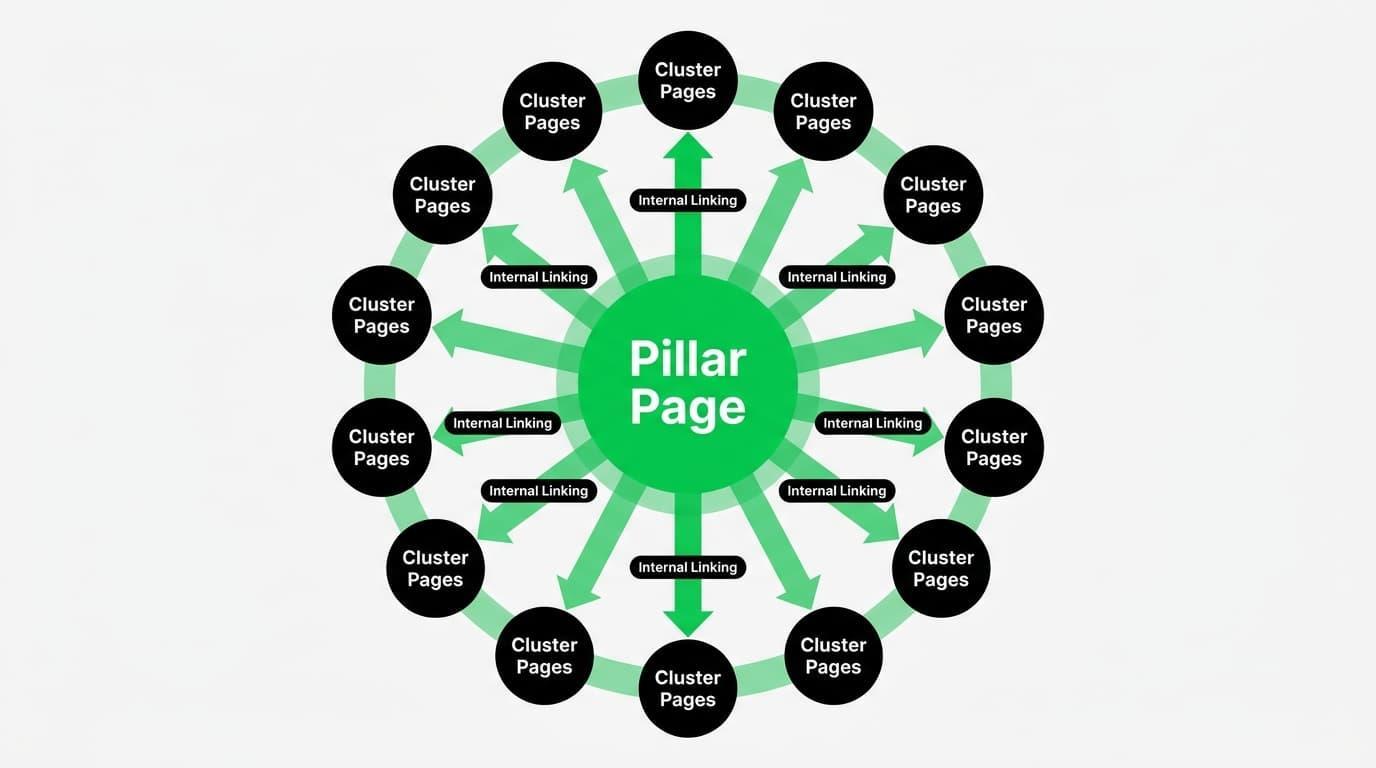
Topic clusters rely on three distinct parts working together. If any one of the three is missing, the model fails to deliver the authority, structure, and ranking strength that make clusters effective in the first place.
The Pillar Page
The pillar page sits at the center of the cluster and covers the core topic broadly. It doesn’t go deep on every subtopic; instead, pillar page content provides broad coverage, introduces associated subtopics, and points readers to the pages and blog posts that explore them in depth. Think of it as the authoritative overview: pillar content built to target a broad term informed by search volume and monthly search volume.
Cluster Pages
Cluster pages cover specific subtopics in depth. Each one usually targets a specific keyword or related keywords rather than the broad term. For example, if a pillar page is targeting a broad keyword like “content marketing,” the cluster pages might cover “what is a content calendar,” “how to repurpose content,” “content marketing KPIs,” and so on.
Instead of briefly mentioning these topics in one massive article, each cluster page explores a single subtopic in detail so it can answer search intent more clearly and rank for long tail keywords with lower search volume.
Internal Linking
Internal linking is the connective tissue that holds the cluster together. It helps build internal links between the pillar and supporting web pages, and sometimes between cluster pages themselves. These links create a structure that helps search engines understand how the pages relate and improves crawling and indexing, reinforcing the site’s coverage of the broader subject.
The easiest way to picture a topic cluster is to think about the hub-and-spoke model used in computer networks. The pillar page acts as the central hub, while each cluster page branches out like a spoke connected back to the center. If those internal links disappear, the structure starts to fall apart. Strategic internal links are what keep the cluster functional as a connected content cluster. Keep the connections strong, and the entire cluster becomes far more powerful than any single page could be on its own.
How Topic Clusters Build Topical Authority
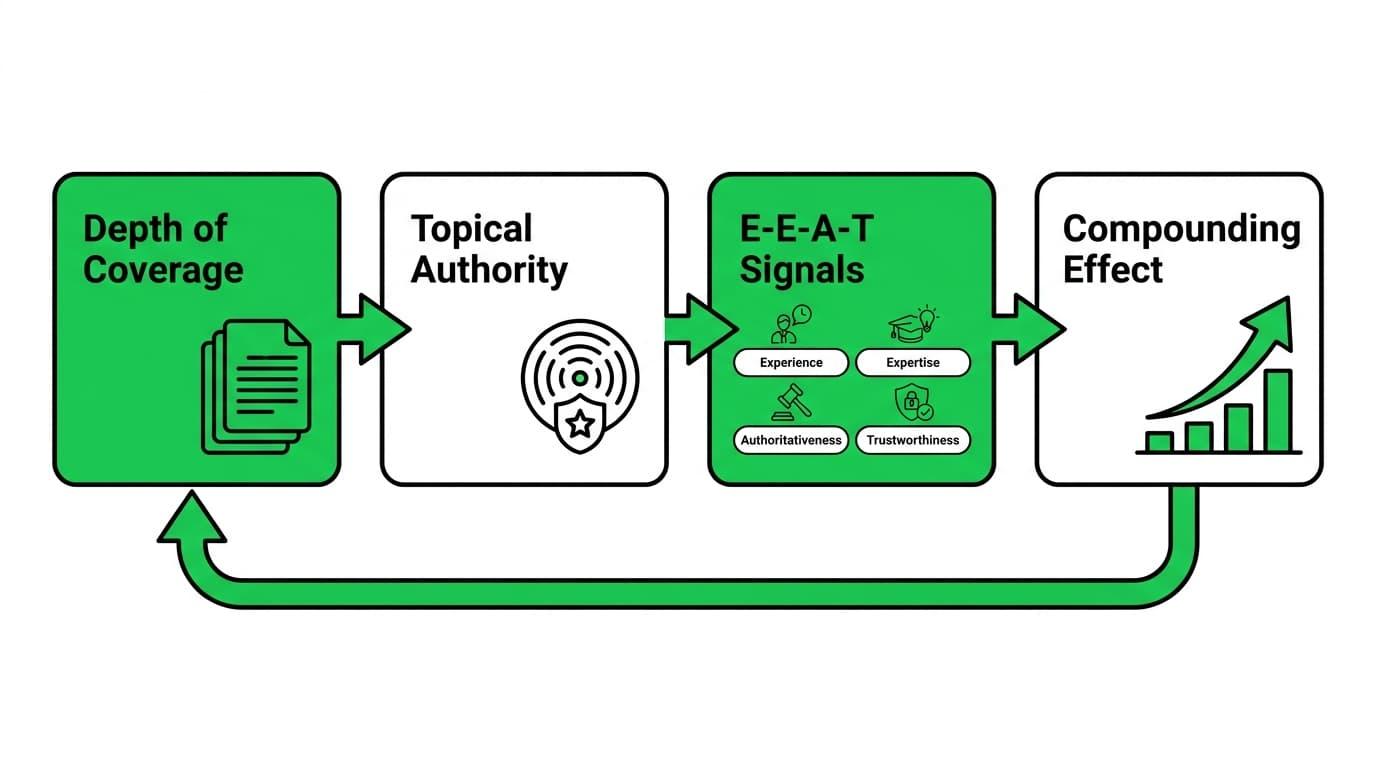
Knowing what a topic cluster is only gets you so far. The more useful question is why this structure actually moves rankings: it helps your content align closely with how search engines evaluate expertise, which is why the structure is so effective for SEO.
Why Search Engines Reward Depth Over Breadth
Search engines don’t usually evaluate individual pages in isolation. They look at how thoroughly a site covers a subject across all of its content and across the different search queries users use to explore it. A site with ten well-connected pages on a topic signals something meaningfully different from a site with one strong page and nothing around it.
That signal is where topical authority starts to develop. When your content consistently answers related questions and covers multiple angles of the same subject with relevant content, you improve your chances of appearing in relevant search results and even the most relevant search results, so search engines begin to view your site as a more reliable source within that niche.
Where E-E-A-T Fits Into Topic Clusters
Topic clusters support E-E-A-T (Experience, Expertise, Authoritativeness, Trustworthiness) by showing search engines that your site covers a subject with depth and consistency. A well-connected group of detailed pages sends a much stronger trust signal than one isolated article surrounded by unrelated content, making it easier for search engines to recognize your expertise and authority.
How Internal Linking Distributes Authority Across the Cluster
Internal linking does more than connect pages; it helps add internal links that distribute authority across related pages, so a well-performing page can pass value to newer or weaker pages nearby.
This is where pillar-and-supporting content creates a compounding effect. When your pillar page earns strong rankings and backlinks, that authority flows through the internal links to the cluster pages connected to it, and those pages should use them strategically to pass context and authority through the structure over time.
Unfortunately, this is also where many businesses struggle. Building a topic cluster isn’t just about publishing related articles. The internal linking strategy, content hierarchy, and keyword mapping all need to work together.
At SEOptimize, we help brands build structured content systems designed to strengthen topical authority and long-term organic visibility.
Traditional Keyword Targeting vs. Topic Clusters
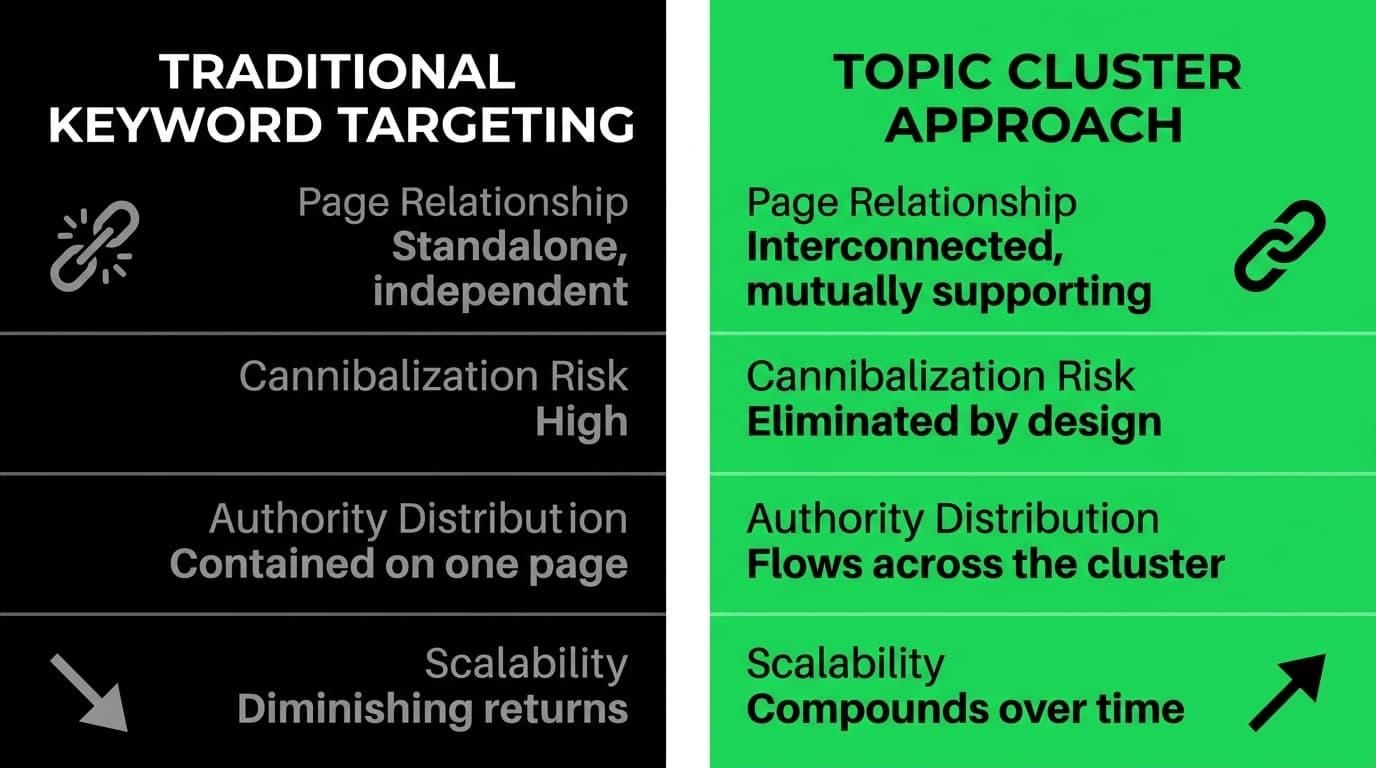
Traditional keyword targeting treats every page as its own standalone unit, whereas a broader seo strategy built around seo topic clusters connects related pages into a clearer system.
Remember how SEO content used to work a few years ago? You pick a keyword, build a page around it, and hope it ranks. That approach is fine, but it’s incomplete for building long-term topical authority.
The problem with that strategy may never show up if your site only has a handful of pages, but it becomes significant as your website grows. Multiple pages start competing for the same or similar terms.
That’s keyword cannibalization, and it quietly erodes rankings across your entire site. Without a content taxonomy to organize how pages relate to each other, there’s no system, just a collection of individual bets.
Topic clusters change the model entirely. Instead of isolated pages competing for attention, you build an interconnected system where pages support each other. The result is a structure where every page makes the others stronger.
This also changes how you use keyword gap analysis. In a traditional setup, you’re looking for terms you haven’t targeted yet.
Inside a cluster strategy, you can identify content gaps more deliberately and spot content gaps within an existing cluster, which is a much more deliberate and defensible approach.
Before building the structure, grouping keywords by intent and reviewing search engine results pages or search engine results can show which terms belong on one page versus separate pages.
Here’s a quick comparison:
| Factor | Traditional Keyword Targeting | Topic Cluster Approach |
|---|---|---|
| Page relationship | Standalone, independent | Interconnected, mutually supporting |
| Cannibalization risk | High | Eliminated by design |
| Authority distribution | Contained on one page | Flows across the cluster |
| Scalability | Diminishing returns | Compounds over time |
Many websites already have enough content to build topic clusters, but the structure behind that content is missing. One of the first things we do at SEOptimize is identify existing content opportunities, uncover keyword cannibalization issues, and reorganize pages into stronger topical clusters that support better rankings.
Note that keyword research still matters as it tells you which cluster pages to build and in what order. Without the structural layer a topic cluster provides, though, that research only gets you halfway there.
The Full SEO Payoff: What Topic Clusters Do for Your Site
The benefits we’ve covered so far don’t work independently from one another. Topical authority, internal linking, and reduced cannibalization all reinforce each other over time. Here’s what that looks like in practice.
Reduced Keyword Cannibalization and Cleaner Site Architecture
One of the quieter problems that grows with every new post you publish is cannibalization. When multiple pages target the same or overlapping keywords, search engines become stuck choosing which one to rank. That split in ranking signals means none of your pages would perform to their best strength.
Topic clusters eliminate this by design. Each page in a cluster has a defined role and a distinct keyword focus. The pillar handles the broad term, and cluster pages own the subtopics. There’s no ambiguity and no competition between different clusters.
This clarity also benefits site architecture. A cleaner site structure across connected pages helps search engines understand the hierarchy more clearly.
The crawlers can see which page is the authority on a subject, how supporting pages relate to it, and how the whole structure fits together, which makes indexing more efficient and ranking signals more concentrated on the right pages.
The result is topic cluster SEO benefits that compound over time. Rankings built on a clean cluster structure tend to hold longer than those built on isolated pages, because the supporting content reinforces the authority of every page around it.
Topic Clusters and AI Citations: The Generative Search Advantage
Search visibility is no longer limited to traditional search results, and a strong topic cluster strategy can improve search engine visibility across AI-powered tools like ChatGPT, Perplexity, and Google’s AI Overviews, which now answer questions directly by pulling information from sources they consider trustworthy and comprehensive.
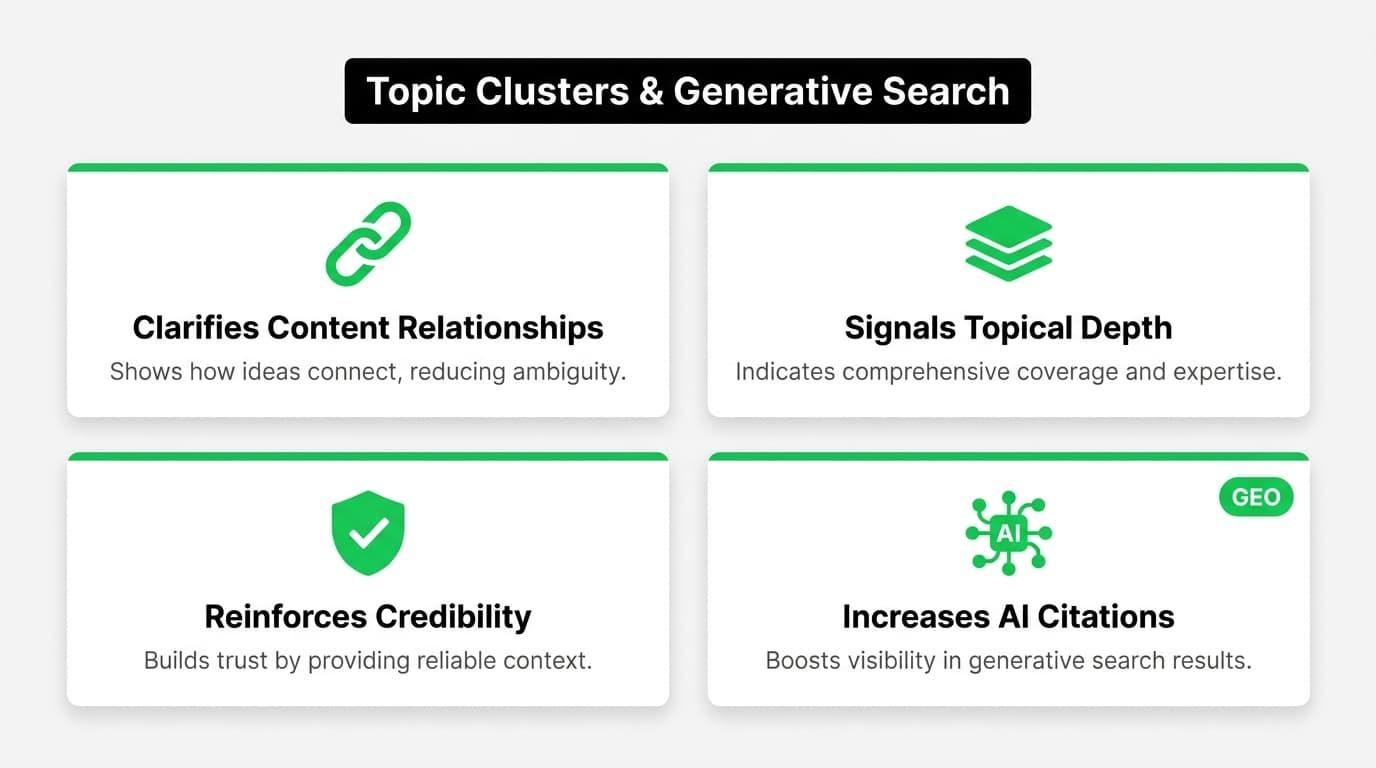
Topic clusters are becoming increasingly important in this environment because AI systems evaluate how well a site covers an entire subject, not just how well one page is optimized. Here are some of the ways clusters help strengthen visibility in AI-driven search experiences:
- Well-structured topic clusters help clarify the relationship between your content pages so those connections are easier to interpret.
- Connected content across related subtopics signals stronger topical depth and expertise.
- Structured internal linking helps reinforce credibility and context across your website.
- Stronger topical authority increases the likelihood of your content being referenced in AI-generated answers.
As AI-driven search continues evolving, content marketers need high quality content and quality content supported by strong structure, not just standalone optimization. At SEOptimize, we build topic cluster strategies that not only support traditional SEO performance but also improve how search engines and AI systems interpret your site’s expertise across an entire subject area.
Research shows that websites using topic cluster architecture receive significantly more AI citations than sites built around isolated content. Generative engine optimization (GEO) is becoming a real reason to cluster beyond traditional SEO.
E-E-A-T signals, topical authority, and structured internal linking all contribute to how AI systems evaluate a source’s credibility, and clusters build all three simultaneously.
Common Topic Cluster Mistakes That Undermine Results
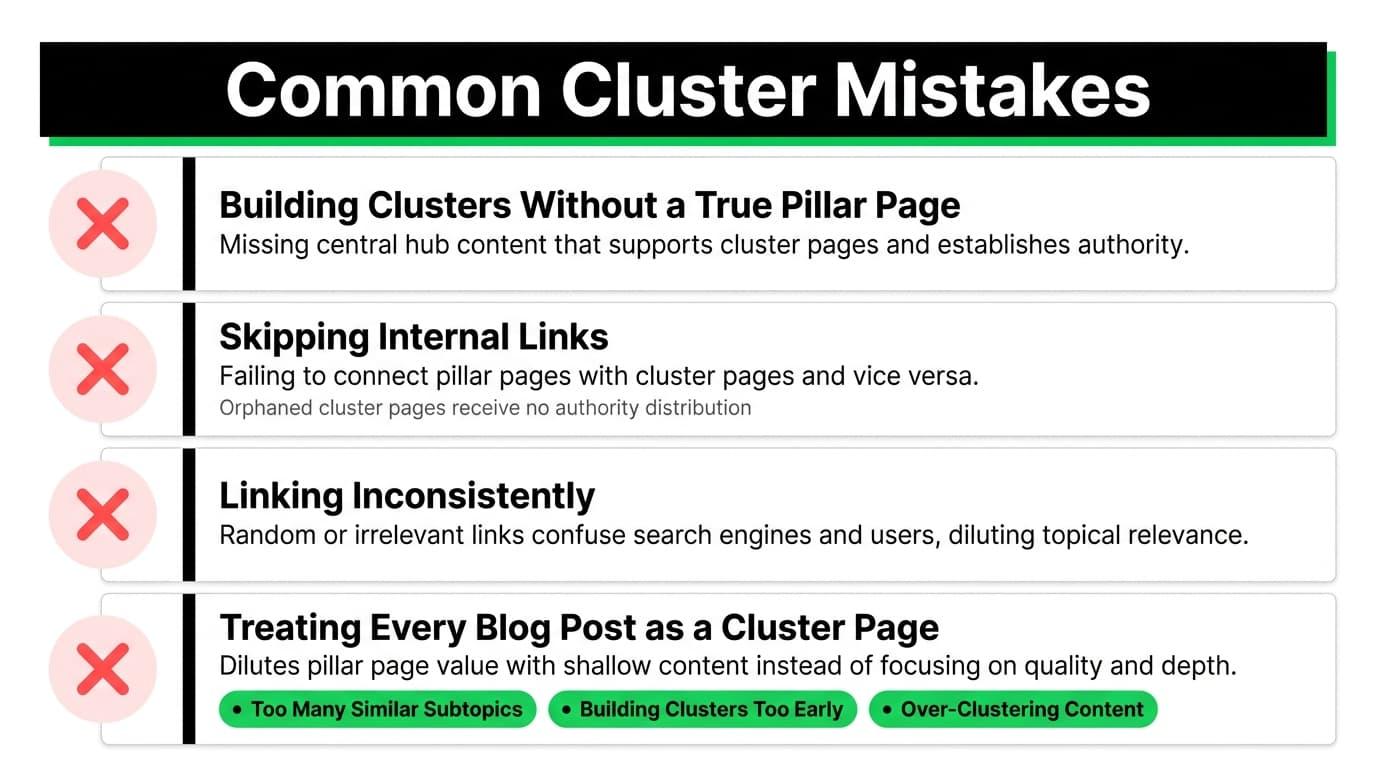
Even a well-intentioned cluster strategy can fall apart in execution. These are the three failure points that show up most often.
Building Clusters Without a True Pillar Page
The pillar page is the foundation of the entire model. If its content is thin, vague, or narrowly focused, it undermines the entire cluster because nothing solid is there to anchor to.
Likewise, a pillar page that runs under 1,000 words or only skims the surface of its core topic cannot signal the breadth of coverage search engines expect.
It needs high-quality content that credibly covers the full scope of the subject, introduces every major subtopic, and links out to the cluster pages that go deeper. Without that, the cluster pages are floating without context.
Skipping Internal Links
Internal linking is what makes a cluster function as a cohesive system. Cluster pages must link back to the pillar page using descriptive anchor text, and where it makes sense contextually, they should also link to each other. Avoid using the same anchor text for different URLs when linking within the cluster.
Orphaned cluster pages, i.e., those with no internal links pointing to or from them, receive no authority distribution from the rest of the cluster. These kinds of pages exist in isolation, which defeats the entire model.
Linking Inconsistently
Inconsistent linking is just as damaging as skipping links outright. If some cluster pages are connected and others aren’t, the structure is incomplete, and the authority signal is fragmented. When you’re building a content plan, mapping internal links at the planning stage, not as an afterthought, keeps the cluster intact from the start. Good topic cluster implementation treats linking as structural, placing it at the core of the content strategy, not an optional step added later.
Treating Every Blog Post as a Cluster Page
Just as not every keyword deserves its own pillar page, not every piece of content belongs inside a cluster. Evergreen standalone content, thought leadership posts, and news-driven articles can coexist outside cluster structures without any problem.
Forcing everything into a cluster dilutes the entire model and creates a new version of the same problem clusters were designed to solve. When building clusters, here are signs you should watch out for:
- Too Many Similar Subtopics: Creating multiple pages around nearly identical topics can reintroduce keyword cannibalization and confuse search engines about which page should rank.
- Building Clusters Too Early: Creating clusters around subjects where your site has little credibility can spread authority too thin before enough trust and relevance have been established.
- Over-Clustering Content: Trying to force every article into a cluster can make your content strategy messy and weaken the purpose behind your internal linking structure.
Clusters work best when they’re built deliberately, not applied to every piece of content by default.
When Topic Clusters Are the Right Move (and When They Are Not)
Topic clusters aren’t a universal fix. They work exceptionally well in the right context, and they can be the wrong starting point in others.
The topic cluster model works best when your website already has enough content to build real depth around a subject. If you only have one or two related articles, there usually isn’t enough coverage for search engines to view your site as a strong authority in that area. In most cases, you need several well-developed supporting pages before a cluster starts strengthening topical authority in a meaningful way.
Businesses targeting competitive, high-volume subject areas usually benefit the most, but search volume alone doesn’t determine whether a cluster is realistic.
When multiple sites are fighting for the same core topic, the depth of the topic on each site becomes the differentiator, and keyword difficulty helps you judge whether you can realistically compete. A well-built cluster is what gives search engines a clear reason to prioritize your site over competitors.
That said, topic clusters are not the right first move for brand-new sites. You need to create foundational pages before planning for a cluster content strategy, so content creation starts with core pages before you scale into clusters. Clusters amplify authority that’s already being built; they don’t create it from scratch.
Furthermore, sites with a very narrow scope or a single product line may not need a full cluster architecture either. A simpler structure can serve those sites just as well without the overhead.
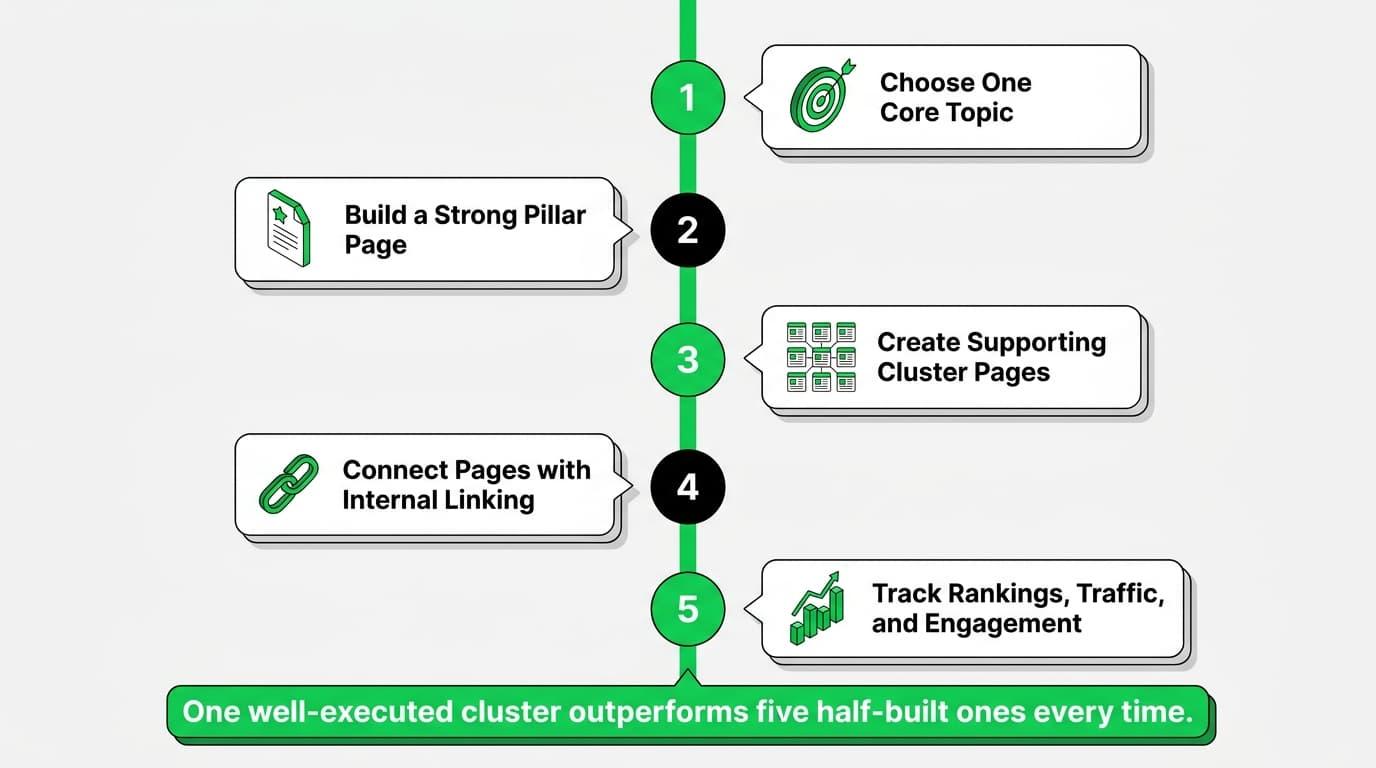
For everyone else, here’s how you can start building and scaling the model effectively:
- Start with one core topic where your business already has real expertise and a clear target audience.
- Build a strong pillar page that broadly covers the main subject.
- Create supporting cluster pages that answer specific related questions in depth and, where relevant, align with stages of the buyer’s journey.
- Connect the pages strategically through internal linking from the beginning.
- Track rankings, traffic, and engagement before expanding into additional clusters.
Take note: There’s no need to build everything at once. One well-executed cluster outperforms five half-built ones every time.
Your Content Should Work as a System, Not a Stack of Pages
Topic clusters are more than just another SEO tactic. They represent a smarter way to build content that compounds authority, strengthens rankings, and improves visibility across both traditional and AI-driven search results. When your content works together as a connected system, every page has the potential to support and strengthen the others around it.
That’s the difference between simply publishing content and building a long-term content marketing strategy that continues to grow over time.
At SEOptimize, we help businesses build content strategies designed around topical authority, structured internal linking, and sustainable organic growth. The results speak for themselves.
Want to turn your content into a system that actually drives rankings and visibility?
Get in touch with us to discuss your content strategy and see how we approach it.
Frequently Asked Questions
What Is an Example of a Topic Cluster?
A travel website targeting “budget travel Europe” is a simple topic cluster example. The pillar page covers the broader subject, while supporting pages focus on subtopics like cheap destinations, train travel, and packing tips, all connected through internal linking.
How Do Topic Clusters Differ from Regular Blog Content?
Regular blog posts are usually created to rank independently around a single keyword. Topic clusters work differently because every page has a specific role within a larger content structure, helping pages support each other through strategic internal linking and topical relevance.
How Do You Start Building a Topic Cluster?
How to create topic clusters from one broad topic starts with choosing a subject your business understands well. From there, identify several related subtopics using primary keywords when deciding which pages to build. Build a strong pillar page, create supporting cluster content, and connect everything through intentional internal linking from the beginning.
Do Topic Clusters Help With AI Search Visibility?
Yes. Topic clusters help AI systems better understand your expertise across a subject area. Well-connected content with strong topical depth increases the likelihood of your website being referenced in AI-generated search experiences like ChatGPT responses and Google AI Overviews.
How Many Pages Should a Topic Cluster Have?
There is no fixed number, but most effective topic clusters contain at least five supporting pages connected to a strong pillar page. The goal is not volume alone, but enough depth to demonstrate clear expertise and topical coverage around a subject.
Can Small Businesses Benefit From Topic Clusters?
Absolutely. Small businesses can use topic clusters to compete more strategically in search results without publishing massive amounts of content. They can start by building a content cluster around one focused area of expertise, then expand as authority grows. A well-structured cluster around a focused area of expertise often performs better than dozens of disconnected blog posts.