If your phone got quieter in late March 2026, you’re not imagining things. Businesses across industries like plumbing, HVAC, legal, and healthcare noticed a drop in calls, form submissions, or website traffic with no idea why, reflecting a sudden decline in their search visibility.
No warning. No explanation. Just fewer leads.
What the majority experienced was the fallout from the Google March 2026 Core Update, one of the more disruptive algorithm shifts in recent memory.
This update reshuffled who shows up in front of ready‑to‑buy local customers and who suddenly disappears from the results they rely on every day. It hit local service businesses hardest when their sites looked generic, lacked real‑world expertise, or were weaker than nearby competitors in the same market.
If you rely on SEO for your local business to keep the phone ringing, these kinds of shifts are impossible to ignore. This article breaks down exactly what happened, which businesses took the hardest hit, and what you can do about it right now.
What the March 2026 Core Update Actually Was
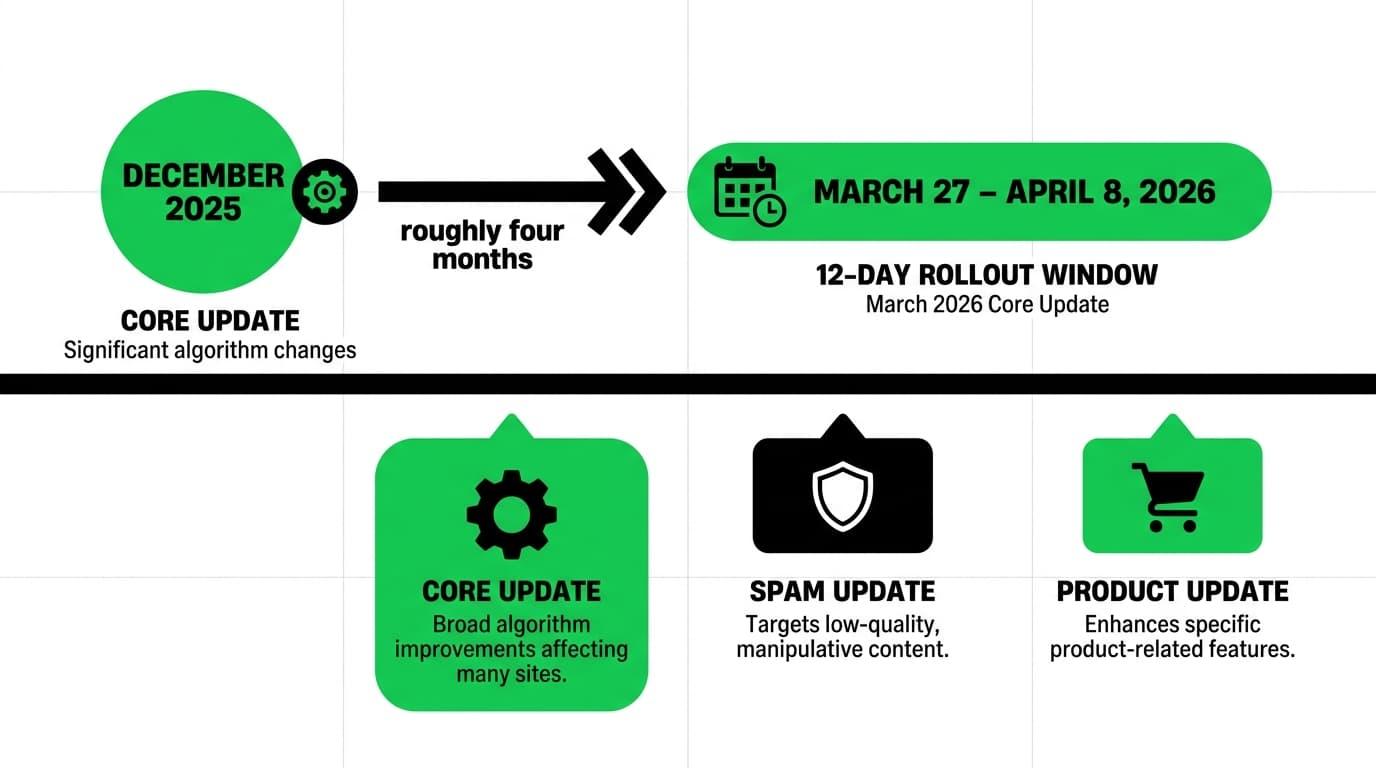
The Google March 2026 Core Update rolled out over a 12-day window, from March 27 to April 8, 2026. Google officially confirmed the update through the Google Search Status Dashboard, the standard channel the company uses to announce and track significant search changes.
This was a broad core algorithm update. What does that mean?
A core update is different from spam updates and product-level updates. Spam updates target specific tricks, while product updates change features such as reviews or shopping results. In contrast, a core update changes how Google judges content quality and relevance across the whole search index. Every category, every industry, and every location can feel the effects.
Core updates often produce the most widespread ranking shifts because nothing is off-limits. For example, a plumber in Phoenix and a law firm in Atlanta can both see movement from the same update, even though they operate in completely different markets.
For context, the previous comparable event was the December 2025 Core Update, meaning two significant core updates landed within roughly four months of each other. As a business owner, it’s worth paying attention to that pace. That’s because it signals that Google is willing to rethink what “quality” looks like several times a year, not once in a while.
The Scope of the Ranking Shifts, in Plain Numbers
The March 2026 Core Update didn’t nudge rankings. It moved them significantly, and the data backs that up.
What 79.5% Volatility Actually Means
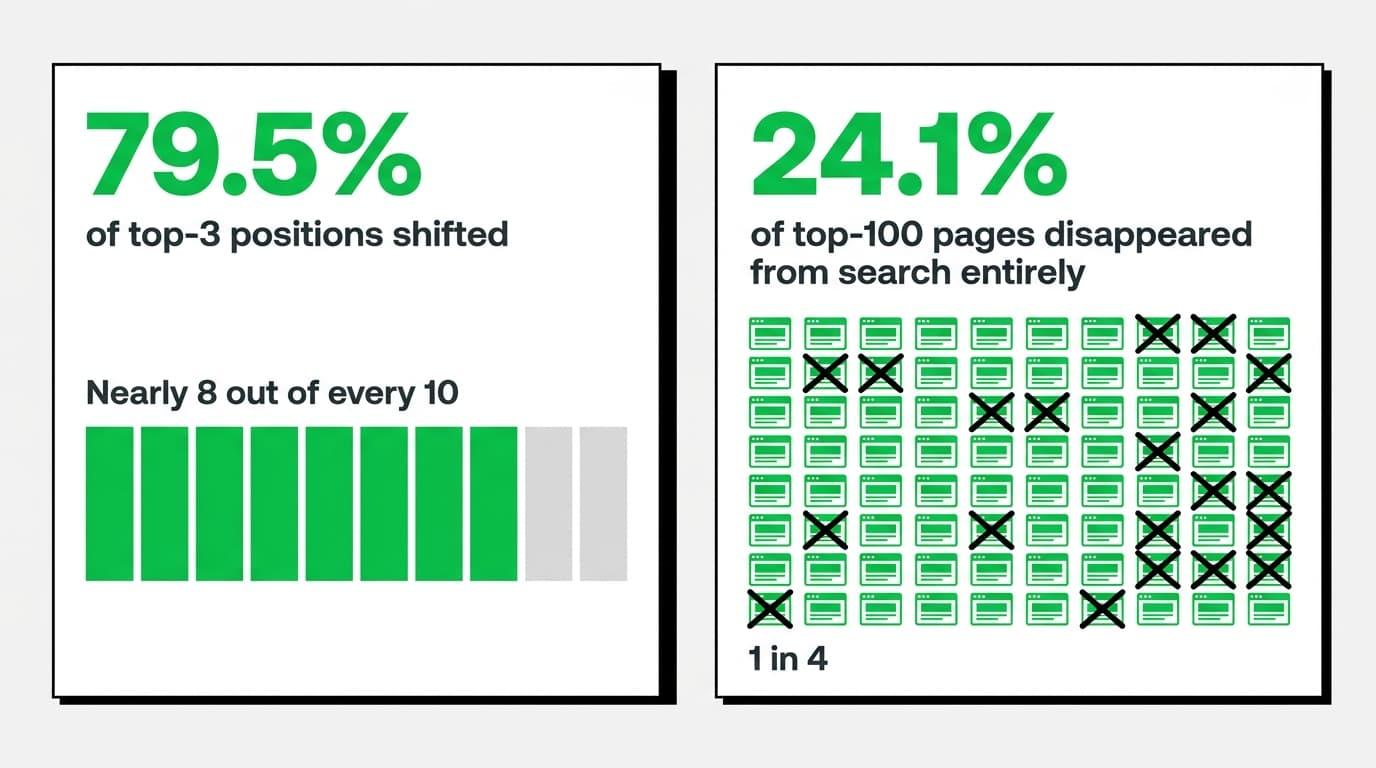
According to March 2026 volatility data, ranking data tracked by Search Engine Land showed that 79.5% of top-3 positions shifted during this update window. That’s not a minor reshuffle. Nearly 8 out of every 10 businesses sitting in the top three spots saw their position change.
For a local service business, the top three results account for most of the clicks, calls, and map pack visibility. What this means is that if your business had been consistently sitting in a top-3 spot before March 27 and then lost it, you likely saw a direct drop in inbound calls and form submissions. That’s not a coincidence; that’s the update.
The practical translation is straightforward: Fewer people saw your business when searching for your service, which means fewer people called.
The 1-in-4 Drop: Pages That Fell Out of the Top 100
The more striking number is 24.1%. That’s the share of pages that ranked somewhere in the top 100 but disappeared from search entirely during the rollout. One in four pages is gone from the first 10 pages of Google.
For a local contractor or service provider, that means a service page that was bringing you steady traffic simply stopped appearing.
Google Search Console would show a sharp drop in impressions and clicks starting around March 27, which is exactly the signal to look for if you’re trying to confirm whether this update affected your site.
If rankings dropped during the rollout, the timing in Search Console is the first clue for diagnosis.
One thing you should note is that not all of these drops are permanent. Some pages rebounded as the rollout stabilized and Google’s systems recalibrated, but many didn’t. That distinction is what you need to understand to decide how to respond.
Do you want to:
- Wait and hope your rankings drift back on their own?
- Take this as a prompt and make a few target improvements on your own?
- Treat this like a serious signal that your pages are underperforming and need expert help to recover?
At SEOptimize, our focus is on helping local service businesses understand why their traffic shifted and which levers they can actually pull, rather than throwing guesses at the wall.
How Google’s Three Algorithm Events in One Month Complicated Everything
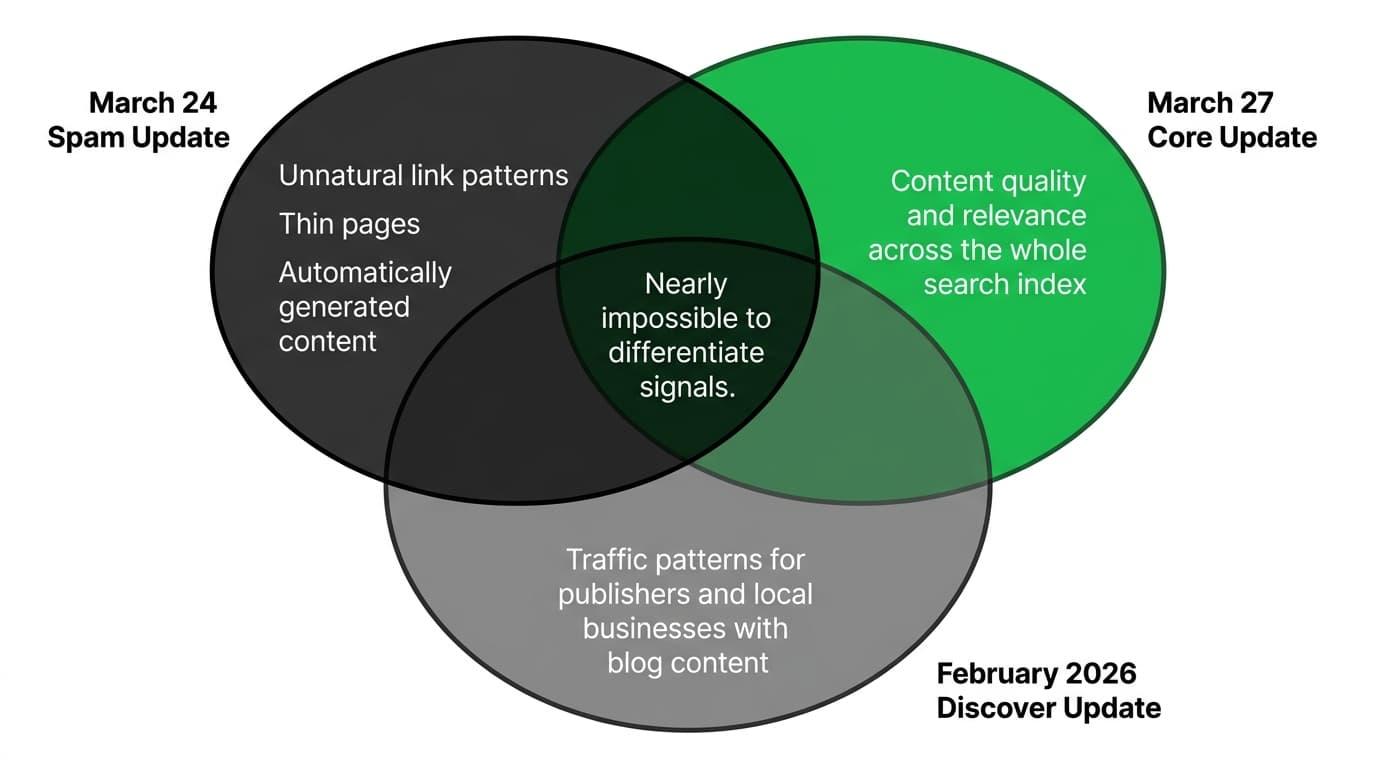
Here’s something most coverage of this update missed entirely: The Google March 2026 Core Update didn’t arrive in isolation. It landed in the middle of two other active algorithm events, and that overlap makes it significantly harder to diagnose what actually happened to your rankings.
Let’s examine each of these algorithm changes.
The March 24 Spam Update Came First
Three days before the core update began, Google rolled out the March 2026 core update rollout alongside a spam update starting on March 24. Spam updates operate differently from core updates, as they’re designed to target:
- Unnatural link patterns that try to manipulate rankings rather than earn them.
- Thin pages that exist mainly to rank rather than to inform.
- Automatically generated or low‑effort content created at scale with little or no human review.
The core update, which followed on March 27, evaluates overall content quality and relevance at a much broader level. Two different systems, two different triggers, both running at the same time.
The February Discover Update Was Still Settling
There was also a third layer to contend with: The February 2026 Discover update was still rolling out when March began. Google Discover, the content feed that surfaces articles and pages to mobile users based on their interests, had already been shifting traffic patterns for publishers and local businesses with blog content.
That update hadn’t fully stabilized before the spam and core updates started. If your business relies on Discover traffic alongside organic search, differentiating the signals becomes nearly impossible.
Why Attribution Matters for Your Recovery Plan
Attribution isn’t just an interesting footnote. It has a direct impact on what you should do next.
Google recommends waiting until the rollout is complete before making major site changes, so attribution is based on stable signals instead of mid-rollout noise.
If the spam update caused your drop, the fix involves reviewing your backlink profile and removing low-quality links. If the core update was responsible, the work centers on content quality and topical authority. Treating the wrong cause leads to wasted effort and no recovery.
Before taking action, identify which event most likely affected your site. The timing of your traffic drop in Google Search Console is the clearest starting point, and the next section on recovery steps walks through exactly how to do that.
Who Lost Rankings and Who Gained Them
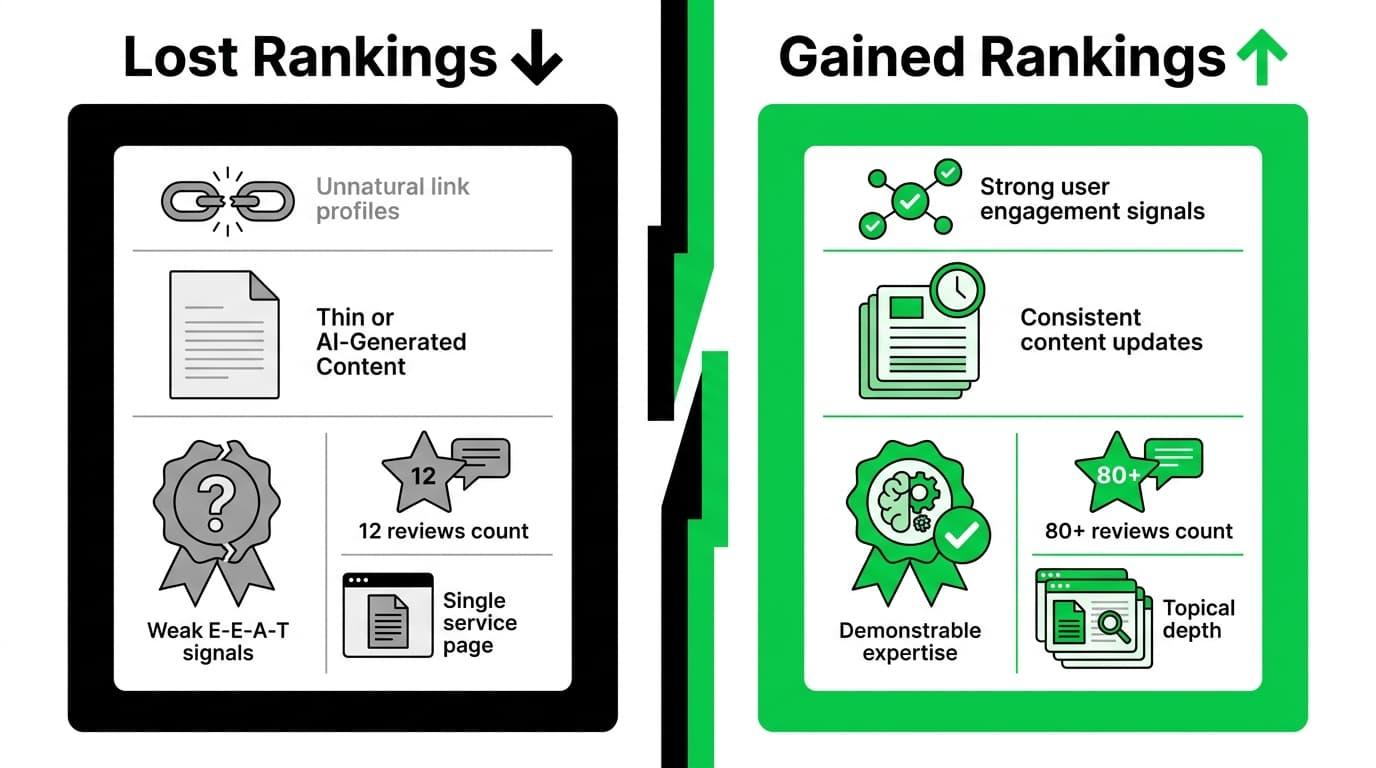
Not every business was affected the same way. The March 2026 Core Update created clear winners and losers, and the patterns are worth understanding before jumping into recovery mode.
Sites That Took the Hardest Hits
The patterns from the March 2026 Core Update point to a clear profile of sites that lost ground:
- Thin or AI-Generated Content: Pages built without human review or real-world expertise behind them dropped significantly.
- Weak E-E-A-T signals: Sites where Google could not find clear evidence that the content came from someone with genuine experience or authority on the topic.
- Unnatural link profiles: Sites caught in the spam update’s crossfire, including those with doorway pages built to rank for a single keyword rather than serve a real visitor.
What Gained Ground After the Rollout
The winners from this update shared a clear pattern. Sites with demonstrable expertise, consistent content updates, and strong user engagement signals moved up in search visibility.
Google’s Gemini 4.0 Semantic Filter, which evaluates how well content matches the actual meaning behind a search query, rewarded pages that answered questions thoroughly and naturally.
Pages and websites that focused on clear, human‑first answers rather than keyword stuffing were the ones that saw gains. Businesses that had invested in building topical depth, covering a subject from multiple angles rather than relying on a single optimized page, held their positions or gained visibility.
Local Service Businesses: A Specific Pattern
Local service businesses were hit in a way that most coverage hasn’t addressed directly. The map pack and local organic results saw disproportionate movement, particularly for businesses with sparse Google Business Profiles and low review velocity.
A plumber with 12 reviews and a single service page was far more exposed than a competitor with 80 reviews and supporting content across multiple service areas.
Businesses relying on one page instead of building out entire sections were more vulnerable. Google is increasingly evaluating the credibility of entire sections, not just individual pages, for local-service topics.
AI Overviews also began surfacing more prominently for local service queries, pulling visibility away from traditional organic listings, which compounded the impact for businesses already losing map pack ground.
The one exception worth noting: Some local businesses actually gained rankings when their direct competitors in the same market took hits. If your competitor lost visibility, your position may have improved by default, even without any changes on your end.
What Google Said About This Update
Google kept its public comments on the March 2026 Core Update high‑level and cautious. Instead of talking about “penalties,” it stressed that the goal was to surface more helpful, trustworthy results for searchers.
For local businesses, the real question became simple: Does your site now meet that higher bar, or did it slip below it?
E-E-A-T and Content Quality: Still the Core Signal
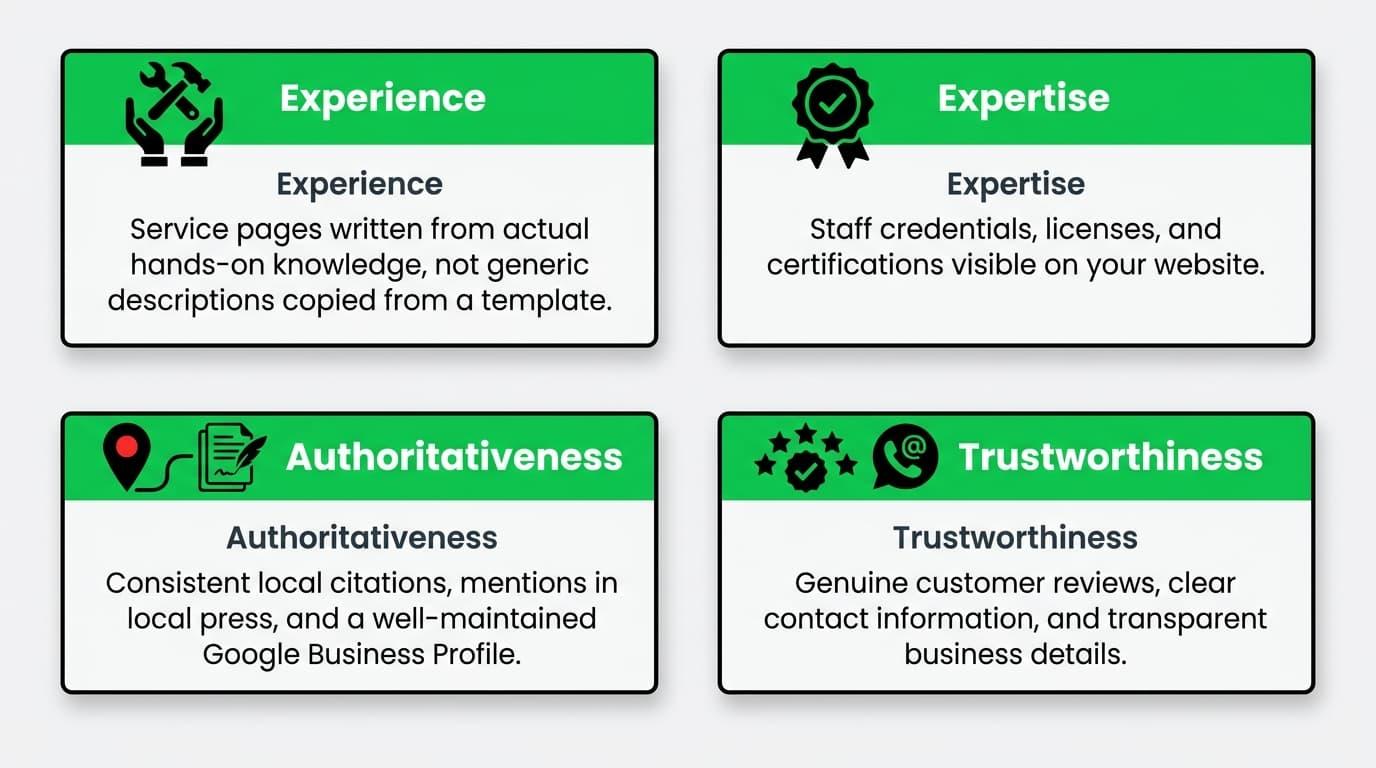
Google’s public statements on the March 2026 Core Update followed a familiar pattern. The company pointed to its core update help documentation and emphasized that the update was designed to reward content demonstrating Experience, Expertise, Authoritativeness, and Trustworthiness, commonly referred to as E-E-A-T, with a preference for content from a credible source showing demonstrated expertise, especially in trust-sensitive categories. No specific industries or websites were named as targets.
For a local service business owner, E-E-A-T is not an abstract concept. It translates into concrete, recognizable things:
A plumber whose website lists their license number, shows real job photos, and has 60+ verified reviews signals something very different to Google than a competitor with a thin, templated site and no social proof. That difference is exactly what this update was designed to surface.
Google also referenced what changed in the March 2026 update regarding Core Web Vitals as a supporting signal, reinforcing that page experience still factors into how quality is assessed alongside content.
AI-Generated Content and This Update Cycle
Google didn’t explicitly penalize AI-generated content in this update, and understanding that distinction matters. The issue was never using AI for content creation. The issue was whether the output delivered original value, real insight, and real expertise after human review.
Pages that used AI as a drafting tool but were reviewed, edited, and grounded in genuine expertise largely held their ground. ai assisted content can still perform when it is substantially edited and backed by editorial oversight. Pages that were generated at scale and published without meaningful human input were far more exposed.
The spam update that preceded the core update targeted manipulative tactics more directly, including thin pages built solely to rank. That is a separate enforcement mechanism, but the two events running together amplified the impact for sites relying on low-effort content strategies. Anonymous content and pages repeating the same things in existing results are increasingly losing ground because Google now treats Information Gain as a primary evaluation signal.
What Local Businesses Should Do Now
If your traffic dropped during the March 2026 update window, the worst thing you can do is guess. The steps below are grounded in what this specific update targeted and what local service businesses can realistically act on.
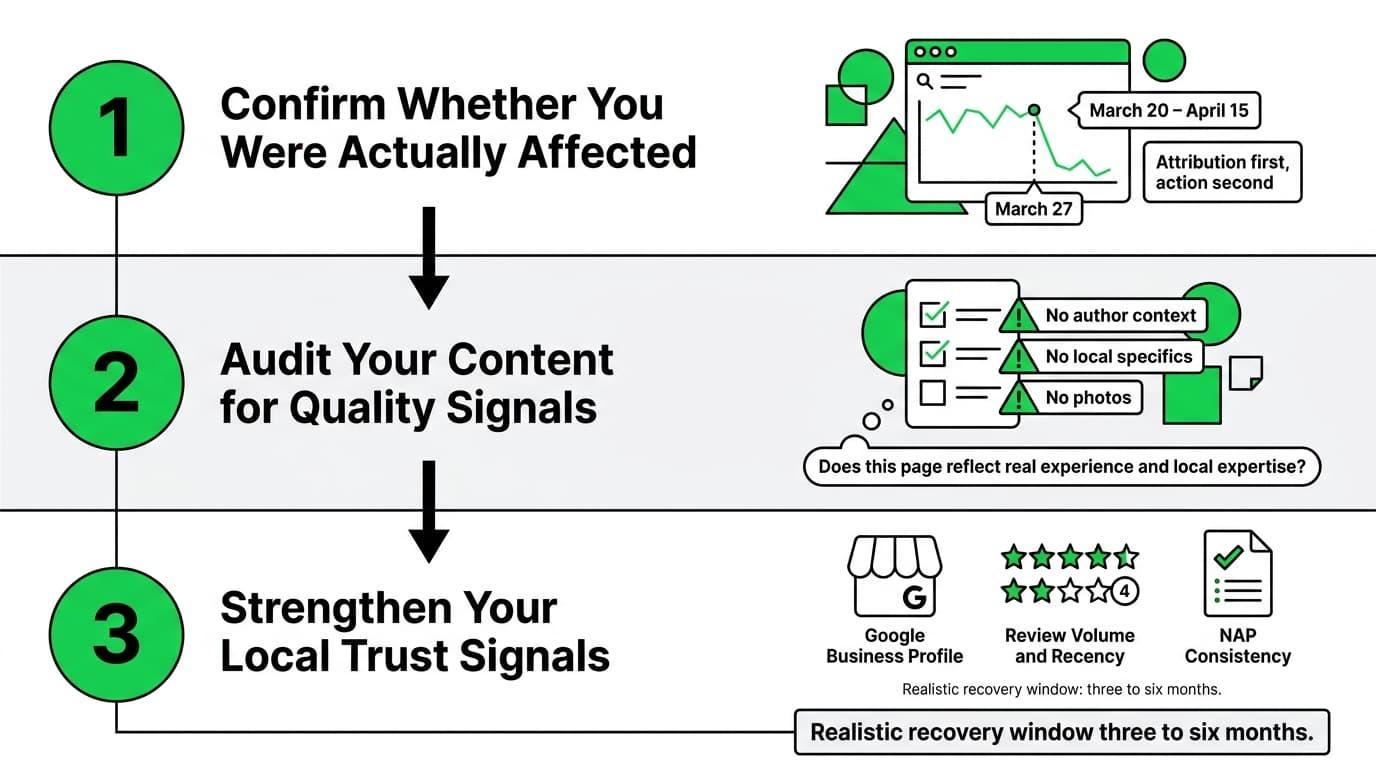
Step One: Confirm Whether You Were Actually Affected
Open Google Search Console and pull your performance report. Compare impressions and clicks from March 20 through April 15 against the prior 30-day period. A sharp drop starting around March 27 points directly to the core update.
Review the same query patterns before and after the update so you can separate page-specific issues from broader demand changes.
If your traffic fell before March 24, neither the spam update nor the core update is the likely cause. If the drop started between March 24 and March 27, the spam update deserves a closer look before you assume the core update is responsible. Attribution first, action second.
This step matters because fixing a spam‑related issue is very different from improving content quality after a core update. Treating the wrong problem wastes time and money.
Step Two: Audit Your Content for Quality Signals
Once you’ve confirmed the core update is the likely cause, look at your most-visited pages that lost traffic. Ask one honest question about each: Does this page reflect real experience and local expertise, or does it read like a generic template? Google is also looking at what the page contributes compared with what already ranks.
The highest-risk pages share a few common traits:
- No author context or credentials listed.
- No local specifics, photos, or real job examples.
- No supporting content around the main service topic.
- Generic descriptions that could apply to any business in any city, especially weak content that adds little original data or relevant content.
A single-page targeting “roof repair in Denver” with three paragraphs, no photos, no credentials, and no customer context is exactly what this update was designed to push down. A post-update SEO audit can help you identify which weak pages are underperforming and why, rather than guessing at the problem. Fewer, stronger pages often outperform a larger set of weaker URLs, especially after high-volume, low-differentiation content saw significant ranking declines. Strengthening E-E-A-T signals on your strongest pages is the most direct lever available after a core update.
Step Three: Strengthen Your Local Trust Signals
Core update recovery for local businesses isn’t only about content. It also involves the trust signals Google uses to evaluate local authority. Start with the basics:
- Google Business Profile: Ensure every section is complete, including services, hours, photos, and business description.
- Review Volume and Recency: A steady stream of recent reviews signals an active, trusted business. Stale review profiles hurt.
- NAP Consistency: Your business name, address, and phone number should match exactly across every directory listing.
Beyond the basics, consider adding staff bios to your website, local case studies, or before-and-after examples from real jobs. These aren’t decorative; they’re the kind of content that demonstrates true experience to both Google and the people searching for your service.
Realistic Recovery Timelines: What to Expect
This is where honest expectations matter most. Recovery from a broad core update isn’t a quick fix, and anyone telling you otherwise isn’t being straightforward with you.
The realistic window is somewhere between three and six months, and that estimate is tied to when Google releases its next broad core update. That is typically when sites that have made meaningful improvements see their rankings reassessed, and those gains often become more visible during the next major core update. Google doesn’t offer a recovery guarantee, and improvements made today may not be reflected until the next update cycle.
You can use SEO forecasting to model how ranking volatility might affect your traffic over the coming months, which helps set realistic expectations rather than waiting in the dark.
Because this first broad core update of 2026 could take up to two weeks to fully roll out, it made sense to wait until the rollout completes and rankings stabilize before judging impact. By mid-April, the update had largely settled.
Some drops from this update won’t recover before the next cycle, regardless of the work done. That’s not a reason to delay, though. Addressing content quality and trust signals now puts you in the strongest possible position when Google’s systems reassess your site.
Recovery work should sit inside a long-term content strategy centered on fewer, stronger pages, not reactive changes during every regular update. The businesses that act now will be better positioned than those that wait.
Your Next Move After the March Shakeup
The Google March 2026 Core Update was one of the most volatile algorithm shifts local businesses have faced in years, and google’s core updates now affect not only traditional rankings in search results but newer AI surfaces too.
If your leads dropped, your rankings shifted, or your traffic disappeared without explanation, you aren’t alone, and the path forward requires deliberate action, not guesswork. Businesses now need visibility in ai search and ai responses, not only blue-link rankings.
Forward‑thinking business owners treat this kind of update as a wake‑up call to tighten up their content, local signals, and overall visibility instead of waiting for things to “go back to normal.”
Want to cut through the noise and understand what actually changed for your site, what’s fixable, and what to prioritize next?
SEOptimize is a partner‑focused SEO agency that works with local businesses to diagnose ranking drops. We focus on strengthening your real-world credibility and rebuilding an organic presence and ai visibility that still performs when Google moves the goalposts again.